

The May Federal Budget changed negative gearing and capital gains tax rules to steer investors away from established properties and towards newly built homes, aiming to ease competition for existing stock while directing more money into new housing supply.
But a second change followed close behind. New borrowing restrictions for residential property through self-managed superannuation funds were introduced, including for newly built apartments, potentially cutting off a source of buyers for new developments at the exact moment the Government wanted more investment flowing into them.
Nerida Conisbee, Ray White Group’s Chief Economist, has analysed the latest ABS lending data for early signs of whether investors are actually changing behaviour. Nationally, the proportion of investor loans directed towards new housing rose from 17.9 per cent in June 2025 to 21.2 per cent in June 2026, with most of that increase occurring in the latest quarter alone, up from 18.0 per cent in March.
“While this sounds encouraging, the actual numbers tell a less positive story,” Nerida said.
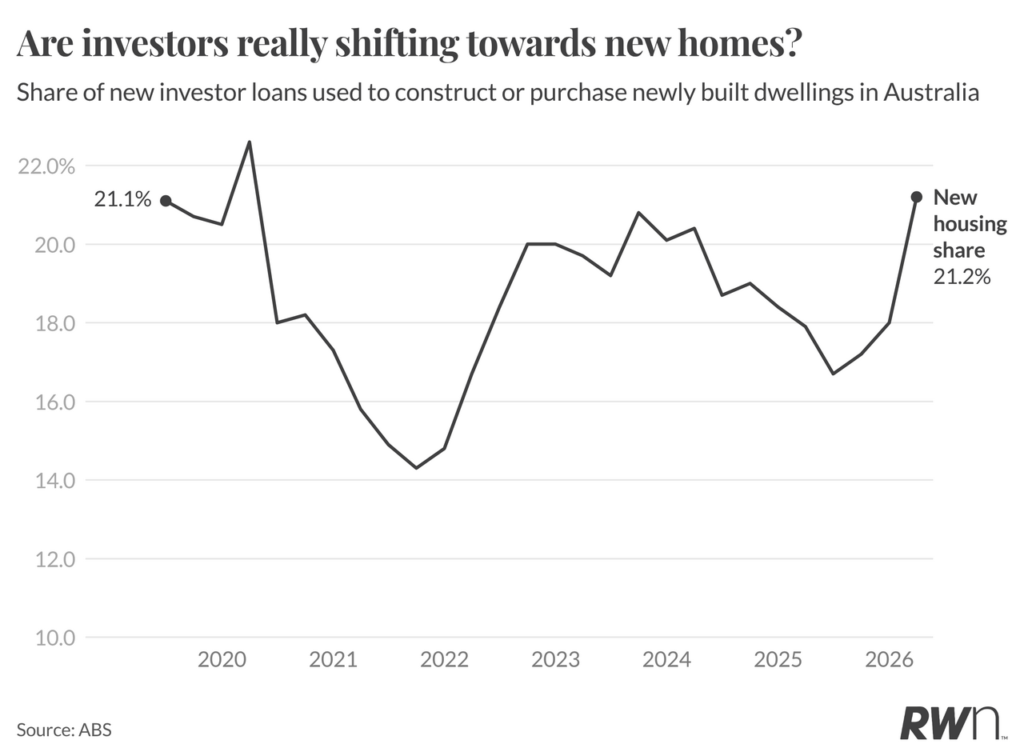
Investor loans for new housing increased by 441 in the June quarter, from 10,482 to 10,923, and by 1,955 over the year.
Over the same quarter, loans for established properties fell by 7,080, from 47,727 to 40,647. Overall investor loan commitments dropped 8.6 per cent during the quarter.
“For every additional investor loan for a new home, there were approximately 16 fewer loans for established properties,” Nerida said.
“The increasing share of new housing is therefore being driven primarily by investors withdrawing from established properties, rather than a substantial increase in investment in new homes.”
The state figures show uneven movement. Over the year, new housing investor loans rose in every state, led by Queensland, Victoria and NSW.
In the latest quarter, however, Queensland added 252 loans and Western Australia 223, while Victoria fell by 21, South Australia by 15, and NSW rose by just 30.
Nerida said the biggest barriers to new development remain high construction costs, expensive finance, skilled labour shortages and projects that don’t stack up financially, and changing investor tax incentives does little to address those problems.
National dwelling completions rose 5.8 per cent in the June quarter to 47,168 homes, and commencements also improved.
But more recent approvals data points the other way. Total dwelling approvals fell 6.1 per cent in August, driven by a 21.2 per cent decline in approvals for private sector dwellings other than houses – a category that includes apartments and townhouses. Detached house approvals rose 3.7 per cent over the same period.
Nerida said investor presales help developers secure finance for apartment projects, and restricting a source of potential buyers through the SMSF changes makes an already difficult environment harder, even though it is too early to measure the full impact on approvals.
“The Budget may be changing where investors buy, but the decline in established housing investment is far greater than the increase in new housing lending,” Nerida said.
“Redirecting investors towards new homes is not the same as getting more homes built. Without addressing the economics of new construction, we are now even further from delivering the housing required to achieve true affordability.”