

Real estate principals and property professionals should brace for an eye-opening reality check this August. More than half of all Australians expect the upcoming Census 2026 to formally document a significant deterioration in their household finances over the last five years.
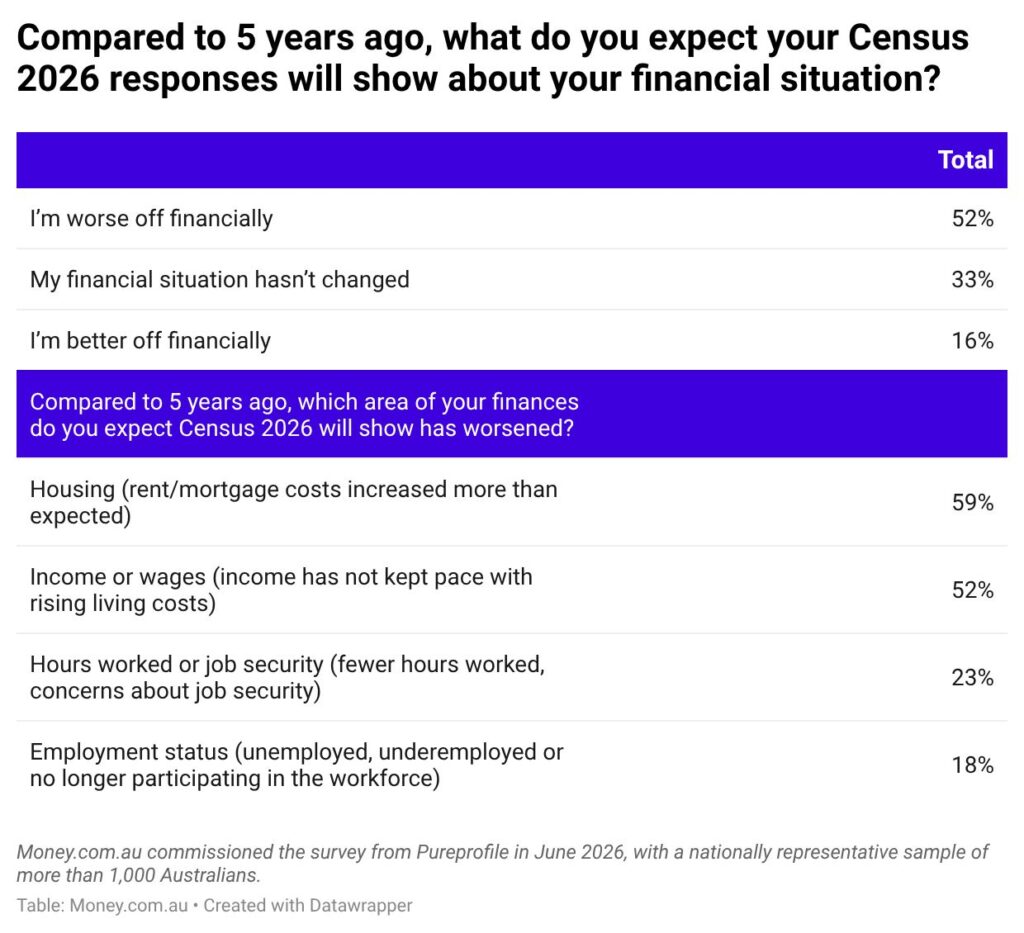
New research from Money.com.au reveals that 52% of Australians, equivalent to roughly 11.5 million people, anticipate their responses will show they are financially worse off than they were during the 2021 Census.
Meanwhile, a third of the population (33%) report that their financial situation has stagnated, while a mere 16% claim to be financially better off today than they were five years ago.
The national snapshot, conducted by the Australian Bureau of Statistics (ABS), is locked in for Tuesday, 11 August 2026. The resulting data is anticipated to serve as a stark reflection of the macroeconomic pressures tightening around everyday households.
Housing Costs Under the Microscope
For real estate principals mapping out business strategies, property management thresholds, and sales pipelines, the data highlights exactly where the financial bleed is happening:
- The Housing Squeeze: Housing costs were identified as the primary catalyst for household financial strain. A dominant 59% of Australians stated that their rent or mortgage commitments have escalated significantly more than expected since 2021.
- The Wage Deficit: Income constraints ranked as the second largest issue, with 52% of respondents reporting that their wages have failed to keep pace with the rising cost of living.
- Demographic Breakdown: Older generations are feeling the brunt of the downturn. Generation X leads the anxiety at 60%, closely followed by Baby Boomers at 53%, both expecting the Census to show a backward financial trajectory.
- Workforce Pressures: Beyond pure housing and wage metrics, 23% noted concerns regarding job security or reduced hours, while 18% cited underemployment or complete withdrawal from the workforce.
A Tale of Two Economies: 2021 vs. 2026
Sean Callery, Head of Insights at Money.com.au, said that the upcoming data will reflect the harsh transition from the pandemic-era economy to the current high-interest environment.
“This year’s Census won’t be a positive report card for either the Government or the Reserve Bank. If most Australians feel they’ve gone backwards financially over the past five years, it’s a sign many households don’t feel the economy has worked in their favour.”
He points out that the baseline set during the last Census was an anomaly that masked the underlying structural vulnerabilities consumers now face.
“We were living in a very different financial environment at the time of the 2021 Census,” Mr Callery explained.
“The country was emerging from the pandemic, the cash rate was sitting at a historic low of 0.10%, and there was far less pressure on household budgets from housing, fuel, insurance and other everyday essentials.”
The direct correlation between consumer sentiment and housing affordability will undoubtedly shape the property market through the back half of the year.
With nearly 60% of the population identifying housing costs as an unmanageable pain point, agencies will likely see continued shifts in tenant stability, rental yields, and listings.
“Housing costs remain a sticking point nationally,” he said.
“Whether you’re paying a mortgage or rent, a growing share of household income is being swallowed by the cost of keeping a roof over your head. That makes it harder to build savings, invest for retirement and feel financially secure, even as wages rise.”