
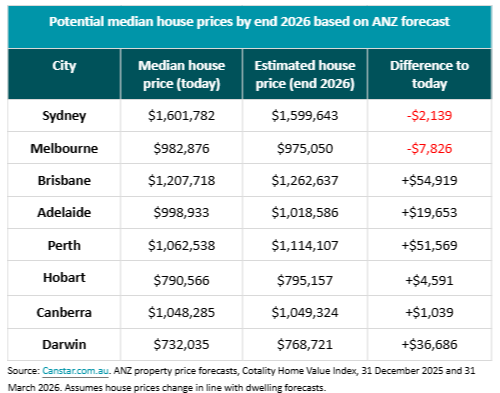
Brisbane and Perth house prices are forecast to climb by more than $50,000 each by the end of 2026, even as Sydney and Melbourne continue to slide, according to new analysis from Canstar based on ANZ forecasts.
Perth leads the charge with dwelling prices tipped to jump 12.3 per cent this year.
Applied to houses, that would push the city’s median from $1.06 million to $1.11 million – a gain of $51,569.
Brisbane isn’t far behind, with ANZ forecasting 9.7 per cent growth that could see median house prices hit $1.26 million, up $54,919 from today.
However, ANZ forecasts suggest the boom in Brisbane and Perth will slow sharply next year, with growth dropping to 1.4 per cent and 1.5 per cent, respectively.
Meanwhile, Sydney and Melbourne are heading the other way.
Sydney’s median house price has already dropped 0.6 per cent since January, and ANZ expects modest falls to continue through the year.
Melbourne is forecast to dip 1.7 per cent.
However, Sydney and Melbourne are tipped to recover modestly, with gains of 2.6 per cent and 2.9 per cent in 2027.
“It’s a tale of two property markets across Australia in a tug-of-war between how much the bank will lend, versus how desperately people need houses,” said Canstar data insights director Sally Tindall.
The divergence comes despite two cash rate hikes already delivered this year, which have cut borrowing power by an estimated $24,800 for a single person earning the average full-time wage.
If Westpac’s forecast of three more rate rises proves accurate, that buyer’s maximum borrowing capacity could shrink by $58,700 in total for 2026.
Yet tight supply is overriding the rate squeeze in Brisbane and Perth.
“Brisbane and Perth property prices are managing to defy the cash rate hikes,” Ms Tindall said.
“Both of these markets are hurtling towards prices that are fast becoming unaffordable for people looking for four walls and a patch of grass.”
For Sydney and Melbourne, the drops offer little relief. Sally noted that borrowing capacity has fallen faster than house prices in those cities.
“News of property price drops will be welcome, but they’re nowhere close to a solve,” she said.
“Already, people’s home buying budgets have dropped by far more than the fall in the median house price in cities such as Sydney and Melbourne.”
Ms Tindall warned that buyers stretching to their limits in rising markets face risks if conditions shift.
“The danger is, people will borrow to the limit, banking on prices continuing to climb. If circumstances change – whether that’s interest rates, job security or the economy – it could leave some households overexposed.”