
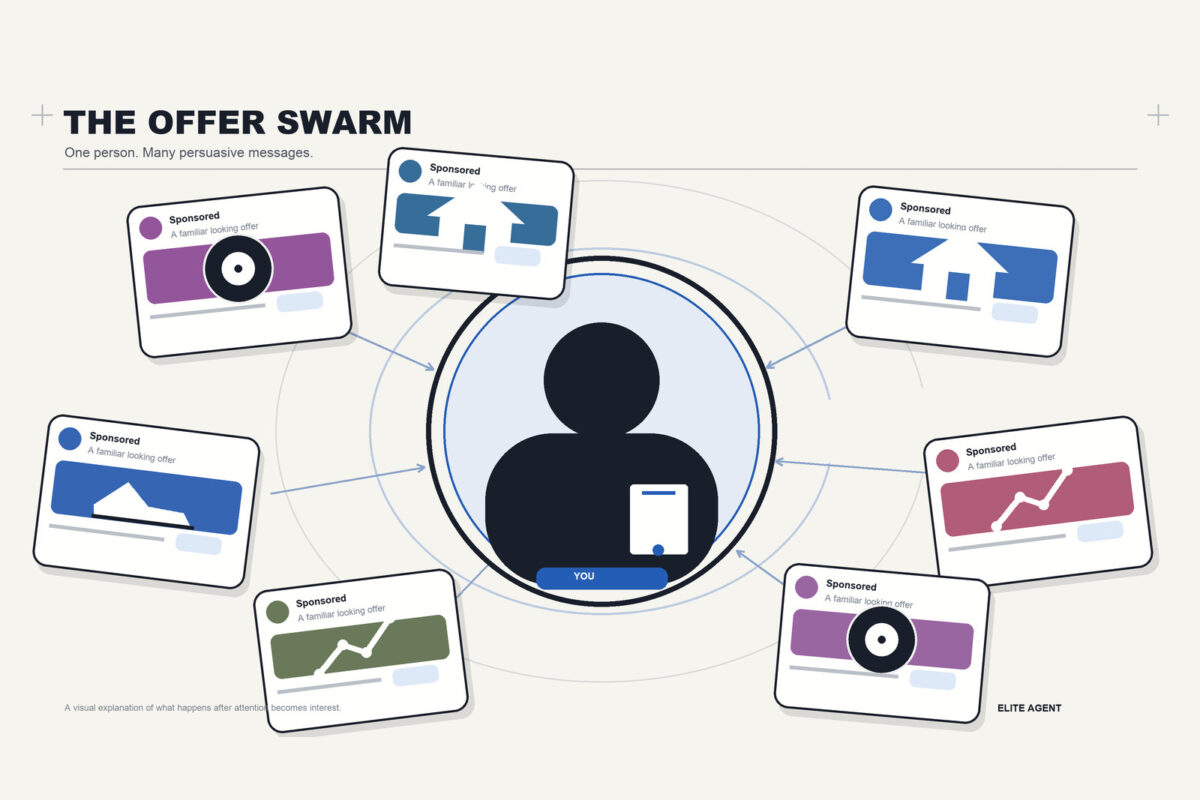
Facebook has made up its mind about me this week.
It is determined that I need to know about the 50th anniversary of Stevie Wonder’s Songs in the Key of Life. Fair enough. In my opinion, it is one of the greatest albums of all time, right up there with Marvin Gaye’s What’s Going On.
It is also showing me Miley Cyrus on that fancy new Peloton treadmill.
I must have posted about my love for all things Peloton once or twice 😬.
In other words, I do know what it’s like to have a subject follow me around the feed.
And after watching Jeremy Haynes explain what he calls the new era of Meta advertising, I’ve been thinking about implications of the customer in the middle of that swarm – both for myself as a publisher and an educator, but also for you agents.
Jeremy describes whats happening right now as a dartboard.
At first, Facebook tries different subjects that might interest you. You pause, click or otherwise show interest in one of them.
Now the ads get closer to that subject. They turn up in the feed, in Reels and in Stories, from the original advertiser and from other businesses with related offers.
His example is a chocolate cake. One cake attracts attention; soon your feed looks remarkably well stocked with dessert (I have had that one too… 😉)
The two campaigns in my feed aren’t competing to sell me the same thing.
They do show what it feels like when several persuasive campaigns are trying to occupy the same small space: my attention.
When a seller starts looking at agents, the offers may be much closer together. They can click on an appraisal ad, encounter another agency’s approach, look up reviews and visit a few websites before speaking to anyone.
That matters because appointing an agent takes more thought than ordering cake.
There may be days or weeks between someone’s first click and your conversation. During those days, they can become much more aware of their choices. By the time you meet, “local knowledge” and “great communication” may be promises they’ve heard several times.
So what could they learn about you before the listing presentation?
Show the decision behind the result
We all suffer the same thing of often having the best material for their brand sitting in our heads.
It might be the reason an agent advised a seller to change course after two weeks. The way they handled honest but disappointing buyer feedback.
Conversely I might look at why the latest articles stats were lower than usual. Does anyone know I’m good at that from my content? Probably not.
But here’s the thing: this is what someone considering your service needs to see: your judgement at work.
Make the first response useful
Imagine that seller requests an appraisal while comparing several agents. If your confirmation says only “Thanks, we’ll be in touch”, you’ve confirmed that the form works. They still know very little about working with you.
You could send a short note explaining what you’ll prepare for the meeting, what you’ll discuss together and two or three questions they might like to consider. What timing matters to them? What are they uncertain about? Which improvements or unusual features should you know about?
Then make the conversation live up to that preview. The first response is part of the service, not simply an administrative step.
Be recognisable wherever they check
Jeremy’s other advice is to be present across the places a person visits while deciding.
For an agent, that could mean a clear website, recent examples of work, useful short videos and reviews that describe the experience of working with you.
You don’t need eight posts a day. You do need the same thoughtful person to be recognisable in the ad, on the website and in the appraisal.
A seller should be able to find an answer to a real question, rather than another version of “we go above and beyond”.
AI can help you see the gaps. Give it your public links and try this:
Imagine you are a seller comparing local agents. Review only the public pages I provide.

What can you clearly understand about how I work? Which claims have examples or evidence behind them? What questions would you still want answered before an appraisal?

Suggest one useful page or short video I could create, and one helpful thing I could send after an enquiry. Do not invent client results, reviews or case studies.
Check its assessment yourself. Better still, ask a recent client what they actually compared and what helped them decide. AI can show you what is visible; a person can tell you what mattered.
Stevie has my attention. Miley does too. Your next seller’s feed will have its own swarm. When your name appears in it, give them something useful to remember: how you think, what you do and how you’ll help when the answer isn’t obvious.
If you’d like to practise this with me, Transform XIV starts on Thursday 1 October. Over 30 days, we’ll use AI to better understand clients, prepare for appraisals and owner meetings, explain your value and follow through – one practical step a day, designed to average 15 minutes. (Registrations close Thursday.)
This column first appeared on Samantha McLean’s Substack, samanthamclean.substack.com.