
Australia’s housing market is under pressure, and the challenge is no longer just an economic headache – it points to a significant challenge for the entire nation’s supply chain.
In a wide-ranging discussion of the nation’s housing ecosystem on the How Housing Became So Broken podcast episode, veteran finance commentator Alan Kohler discussed the federal government’s policy response with his son, Chris Kohler who is also a finance editor.
At the centre of the challenge sits the federal government’s National Housing Accord, which pledged to construct 1.2 million well-located homes over five years.
Alan said the figure was little more than political theatre.
“The target is a political round number,” he said.
“It was a million. Sounded nice. Politically, it was good on a press release… It actually happens to be the same number of houses that were built in the previous five years. What they were aiming to do was to do the same in the next five years as they did in the past five years, but they’re not doing it.”
To hit the target, Australia must complete 240,000 dwellings annually. Instead, completions are running at roughly 180,000, leaving a compounding deficit of over 100,000 homes.
“They’re running at about 180,000 a year at the moment and have done from the beginning of the accord… so they’re 110,000 to 120,000 short at this point,” Alan said.
“When challenged on this stuff, the housing minister and the prime minister and the treasurer always say, ‘Well, look, it’s an aspirational number.’ Okay, fine.”
Going backwards – the global comparison
Citing data from the Grattan Institute comparing dwellings per 1,000 people across developed nations between 2000 and 2021, Australia stood out as one of only five countries where housing stock per capita went backwards.
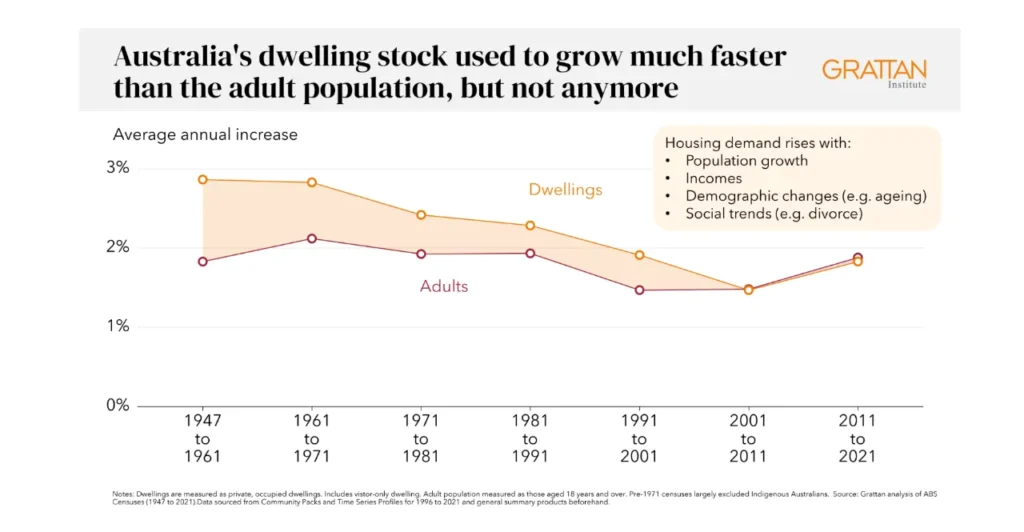
“Why are we one of the only ones going backwards?” Chris asked.
“There are two main reasons,” Alan replied. “One is that there has been a zoning issue, a planning problem of not enough places being approved by councils. And secondly, we’ve got a shortage of construction workers.”
The labour deficit in Australia is significant. Master Builders Australia estimates a shortage of 115,000 residential construction workers, rising to 300,000 across the broader building sector.
Yet, migration pathways continue to limit the sector.
“If you look now at the Australian immigration system, it’s an absolute nightmare,” Alan said.
“They have this tiered system… and construction is on tier three, which means that the number of construction workers coming in is minimal. A big part of the reason we have very solid limits on construction workers coming in through migration is the CFMEU, which doesn’t want it… because it would lead to lower wages and give them less power.”
“No timber, no trusses, no homes” – materials under pressure
Even if builders could secure trades, the physical materials required to erect frame and truss assemblies are reaching a significant bottleneck.
Speaking at Parliament House for National Forestry Day, Housing Industry Association (HIA) Chief Executive Industry and Policy, Simon Croft, issued a warning to lawmakers.
“Australia’s rising population will require hundreds of thousands of additional homes in the years ahead, and a secure domestic supply of timber is fundamental to achieving that outcome,” Simon said. “Timber remains one of the most important building materials used in Australian homes and is a cornerstone of residential construction across the country.”
Simon said recent years demonstrated how rapidly supply constraints can affect housing affordability and project delivery timelines.
“The experience of recent years demonstrated how quickly supply constraints can affect housing affordability, construction costs and project delivery timelines,” Simon warned.
“As governments work to increase housing supply across Australia, it is critical that building material supply keeps pace with demand… No timber, no trusses. No panels, no kitchens. No manufacturers, no homes – it’s that simple.”
The cost of these material and labour shortages is being felt by consumers, with average borrowing for home renovations rising 19% in a single year, according to HIA data.
Tax policy and immigration pressures
Demand-side factors have put further pressure on the market and Alan traced the roots of asset price increases back to John Howard’s 1999 decision to halve the Capital Gains Tax (CGT).
“In the following three years, house prices rose 45%,” he said. “There’s a clear connection between the capital gains tax discount and the increase in housing investment, which drove housing prices.”
This was compounded by record post-pandemic net overseas migration that outpaced Treasury forecasts.
“In 2022, Treasury predicted immigration would be 180,000 – turned out to be 500,000. Oops,” Alan said.
“Year after that, Treasury predicted 230,000 – turned out to be 460,000. Oops. What that tells you is the government didn’t even know what was going on. Over two years, a million people came in… Led to a massive housing shortage.”
For developers and real estate investors, structural supply constraints mean price pressure will remain elevated long term.
Highlighting a recent conversation with HIA Chief Economist Tim Rearden, Alan said that current market corrections offer a short-lived window.
“[Tim Rearden] said, ‘No, no. This year is actually a massive buying opportunity for property investors because there is not enough construction labor to turn it around,'” Alan recounted.
“His point of view is that house prices are going to start rising again as soon as this correction is finished… because there isn’t going to be enough supply because there aren’t enough tradies.”
Alan argued that the only sustainable fix is a total overhaul of national priorities.
“You have to reform the immigration system in such a way that we prioritise construction,” Alan concluded. “That’s what we have to do, and that is not happening.”
Watch Chris and Alan Kohler on How Housing Became So Broken podcast episode here.