
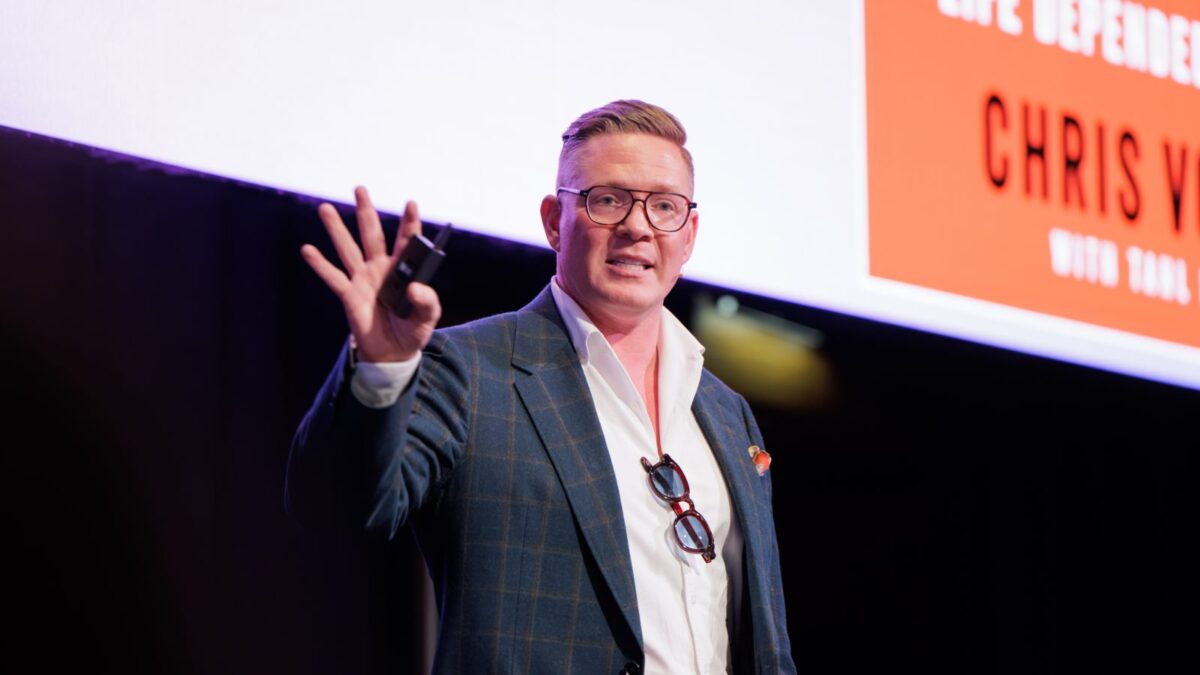
When Anders Sörman-Nilsson’s doctor asked to use an AI medical scribe during his appointment, the benefit she described was something he could see: she could keep looking at her patient.
Instead of turning away to capture medical notes, she could maintain eye contact while the technology helped with the paperwork.
For Anders, it was a practical example of the future he wanted property managers to consider at PM/ONE 2026 – a working day with more room for the people they serve.
The futurist told delegates his doctor had described spending two to three hours a day on paperwork. In his account, AI assistance with notes and referral letters was returning that time to patient care.
The point was the work that became possible when administration took up less of the day. For property managers, he asked, what would change if technology gave them more time with landlords and tenants?
Keep the human connection
That question runs through Anders’s own family history.
His great-grandfather established a menswear business in Stockholm in 1916, building it around personal service and the relationships formed in a physical shop. Generations later, his mother still placed enormous value on a smile and a human interaction.
Anders described the tension between that tradition and customers whose decisions increasingly involved digital channels. His argument was that businesses needed to understand the strengths of both experiences.
He encouraged property managers to examine their service from each side of the relationship: the landlord’s and the tenant’s.
Where does a face-to-face interaction work particularly well? Where does a digital process make something easier? And where could the strengths of one compensate for the weaknesses of the other?
His doctor’s use of an AI scribe illustrated that combination. The technology supported the interaction between two people and reduced the administrative demands competing for their attention.
Look beyond the faster email
Anders also urged delegates to explore what AI could do beyond producing written responses.
He described AI agents that could carry out tasks on someone’s behalf, and predicted property managers would increasingly encounter agents representing landlords and tenants in property decisions.
That was a forecast about how client interactions could develop, alongside a more immediate invitation to examine the work already filling their days.
He pointed to DocuSign as an example of a technology that sped up a familiar process and subsequently became something clients expected.
“But remember this, today’s luxury is tomorrow’s expectation,” Anders said.
For agency leaders, the useful question was where similar friction remained in their own service – and what they could improve before clients began to expect it.
He encouraged delegates to retain their curiosity as the tools developed. Conversational interaction with AI, he said, meant people could work with the technology in their own spoken language, without needing a software engineering background.
Draw the day you want
Anders’s most practical assignment required a pie chart.
First, he asked delegates to take an honest look at where their time went: what proportion of the working day was devoted to each task, and how much of that work added value for landlords and tenants?
Then came a second chart, showing how they would prefer to spend their day with AI support.
“Put a yellow Post-it sticker on your desktop or on your mobile or whatever you use to remind yourself to think AI first every day,” Anders said.
The second chart was an opportunity to make room for more meaningful work and reduce routine administration.
He suggested exploring tools through theresanaiforthat.com as a starting point for workflows delegates wanted to improve, while also speaking with their IT department.
For leaders introducing those changes, he recommended explaining the better work people could do as a result. Simply telling a team its work would become different gave employees less reason to welcome the change.
He also encouraged leaders to look for curiosity when recruiting, alongside people’s ability to combine technology with emotional intelligence and creativity.
Make room for belonging
Anders returned to the human purpose of property management at the close of his keynote.
Property managers help people move, settle, and become part of a community. In a world increasingly populated by synthetic content and digital interactions, he saw enduring value in those physical connections.
“Utilise the technology to facilitate more of that sense of belonging,” he said.
“Start preparing for a future where the robot is out of the human, and humans get to do what humans do best: build connection and community.”
Actionable
- Map your working day by task in a productivity pie chart.
- Draw a second chart showing your preferred allocation of time.
- Assess physical and digital service from landlords’ and tenants’ perspectives.
- Explore AI tools for routine workflows with your IT department.
- Explain technology changes through the more meaningful work staff could do.