

For agents helping buyers weigh up whether to purchase a larger home, the figures show that the premium for an additional bedroom depends not only on location, but also on property type and the level of accommodation being sought.
According to Ray White Group economist Atom Go Tian, upgrading from a three-bedroom house to a four-bedroom house typically costs an additional $175,000 nationally, or around 21 per cent, when comparing median prices within the same suburb.
However, the difference between Australia’s cheapest and most expensive suburbs is substantial.
In Kings Park, Melbourne, the median price of a three-bedroom house is $645,000, compared with $705,000 for a four-bedroom property.
That means buyers can secure an additional bedroom for just $60,000, or 9.3 per cent more, making it the cheapest suburb in the analysis for a house upgrade in dollar terms.
At the other end of the market, buyers in Melbourne’s Toorak face a very different proposition.
The median price of a three-bedroom house is $3.29 million, rising to $5.73 million for a four-bedroom home, representing a $2.44 million premium.
“In context, it’s a bargain. Kings Park is the cheapest suburb in dollar terms to get an additional bedroom, and $60K is about a third of the typical $180K it costs in Melbourne,” Mr Go Tian said in his analysis.
“Compare that with Toorak, where an additional bedroom costs $2.44 million.”
Canberra leads house upgrade costs
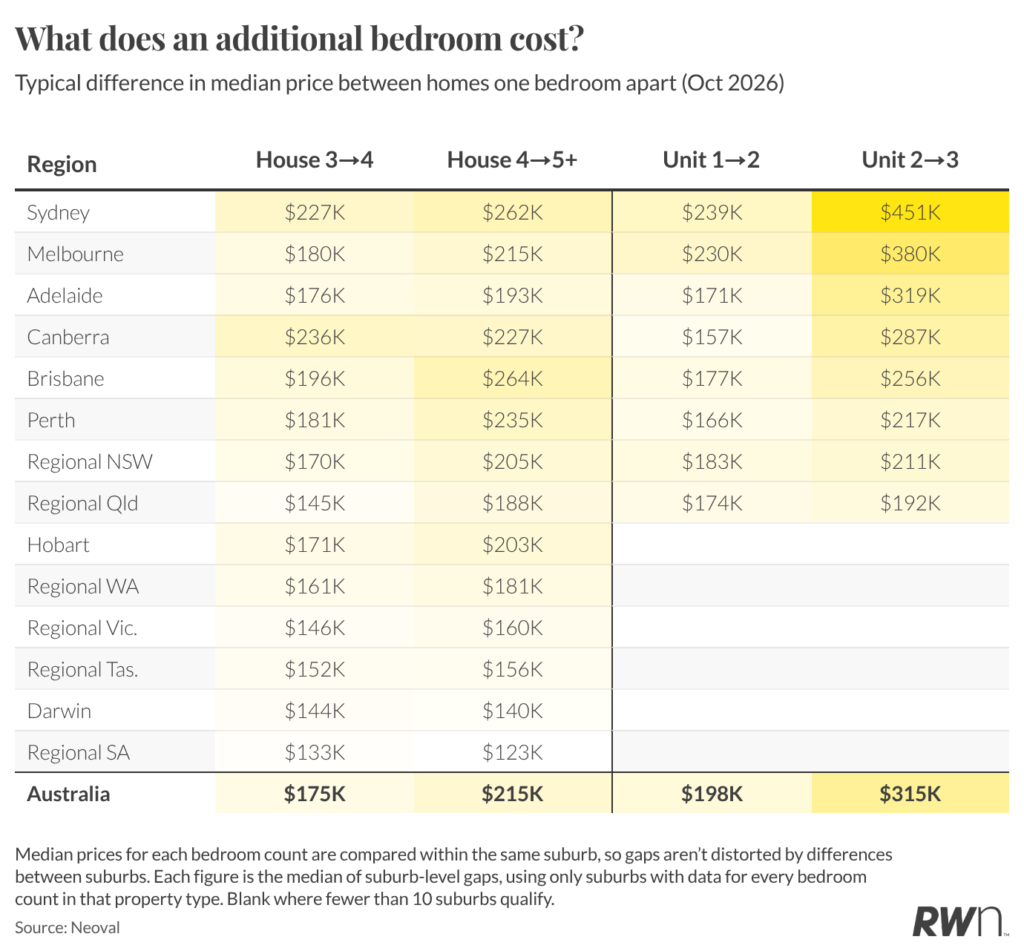
The analysis found Canberra was the most expensive capital city in which to upgrade from a three-bedroom to a four-bedroom house, with buyers typically paying an additional $236,000.
Sydney followed at $227,000, while Melbourne’s typical premium was $180,000.
Regional markets offered some relief, although the savings were relatively modest, with bedroom upgrades generally costing between $20,000 and $60,000 less than in their nearest capital city.
The cost also increases when buyers move into larger family homes.
Nationally, upgrading from a four-bedroom house to one with five or more bedrooms typically adds $215,000, around $40,000 more than the premium for moving from three to four bedrooms.
Brisbane recorded the highest premium for this category at $264,000, narrowly ahead of Sydney at $262,000.
Regional South Australia emerged as the most affordable market for both house upgrade categories, with an additional $133,000 required to move from three to four bedrooms and $123,000 to move from four to five or more.
Why an extra bedroom can cost more in an apartment
While houses generally command higher purchase prices than units, the analysis revealed that moving to a larger apartment can be considerably more expensive in percentage terms and, in some cases, in dollar terms.
Nationally, moving from a one-bedroom unit to a two-bedroom unit adds approximately 41 per cent to the purchase price.
Upgrading from two bedrooms to three adds more than 46 per cent, compared with around 21 per cent for a three-to-four-bedroom house upgrade.
In dollar terms, buyers typically pay an additional $315,000 to move from a two-bedroom unit to a three-bedroom unit, almost double the $175,000 premium for an additional bedroom in a three-bedroom house.
Sydney recorded the highest capital-city premium for a two-to-three-bedroom unit upgrade at $451,000.
The difference partly reflects the relative scarcity of larger apartments and the types of properties available at the upper end of the market.
Three-bedroom units account for around three in 10 unit sales in the analysis, while in premium suburbs they can also represent a substantial step up in quality, amenities and lifestyle.
The disparity is particularly pronounced in Sydney’s prestige apartment market.
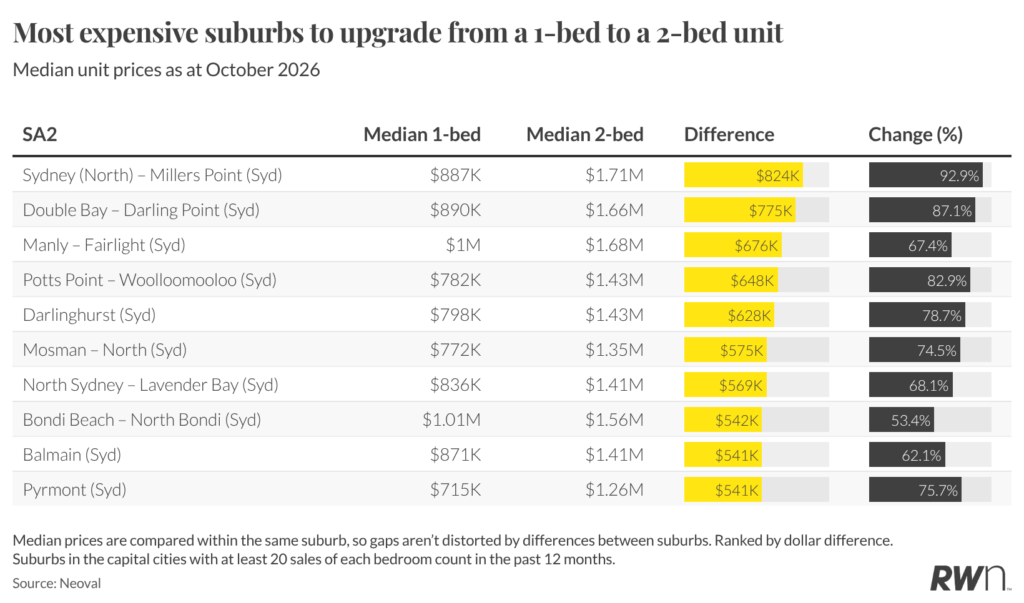
In Sydney (North)-Millers Point, moving from a one-bedroom unit to a two-bedroom property costs an additional $824,000, representing a 92.9 per cent premium.
The same area also recorded the country’s highest premium for upgrading from a two-bedroom unit to a three-bedroom unit.
Median prices rise from $1.71 million to $4.45 million, an extraordinary $2.74 million difference, or approximately 160 per cent.
Sydney accounted for all 10 of the most expensive suburbs for one-to-two-bedroom unit upgrades and nine of the 10 most expensive suburbs for moving from two bedrooms to three.
What the figures mean for agents
For agents, the findings highlight the importance of understanding how buyers value additional accommodation within individual markets, rather than assuming that bedroom premiums follow a consistent pattern.
The cheapest suburbs for house upgrades were generally located on the outer edges of Australia’s major cities.
Melbourne and Brisbane each accounted for three suburbs in the 10 cheapest locations, while Sydney’s most affordable options were concentrated in the city’s west and south-west.
In Bidwill-Hebersham-Emerton, buyers typically pay an additional $65,000 for a fourth bedroom, although the median three-bedroom house price is already $844,000.
For units, Liverpool-East in western Sydney recorded the cheapest one-to-two-bedroom upgrade at $67,000.
Meanwhile, Rothwell-Kippa-Ring in Brisbane offered the cheapest two-to-three-bedroom unit upgrade at just $44,000, with median prices increasing from $621,000 to $665,000.
Larger units were also more common in Brisbane, where three-bedroom properties accounted for 38 per cent of unit sales, compared with 22 per cent in Sydney.
At the prestige end, Sydney’s Bondi-Tamarama-Bronte and Paddington-Moore Park followed Toorak as the most expensive locations for house upgrades, with premiums of $1.38 million and $1.37 million respectively.
The research also examined 925 capital-city suburbs, finding that areas with the greatest variation between their cheapest and most expensive homes tended to command higher premiums for a fourth bedroom, even after accounting for overall suburb prices.
This suggests buyers in prestige markets may be paying for much more than an additional room, with larger homes often representing a significant improvement in property quality and features.
For agents advising upsizers, the distinction could be particularly relevant when comparing homes across different price brackets and explaining why seemingly similar bedroom upgrades attract vastly different premiums.
As Mr Go Tian concluded, the cost of an additional bedroom is rarely just about the extra floor space.
“Units are different. The jump in cost is much bigger because often you’re not only paying for more space; an additional room can nearly double the price because it comes with a full upgrade in amenities, service, and lifestyle.”