
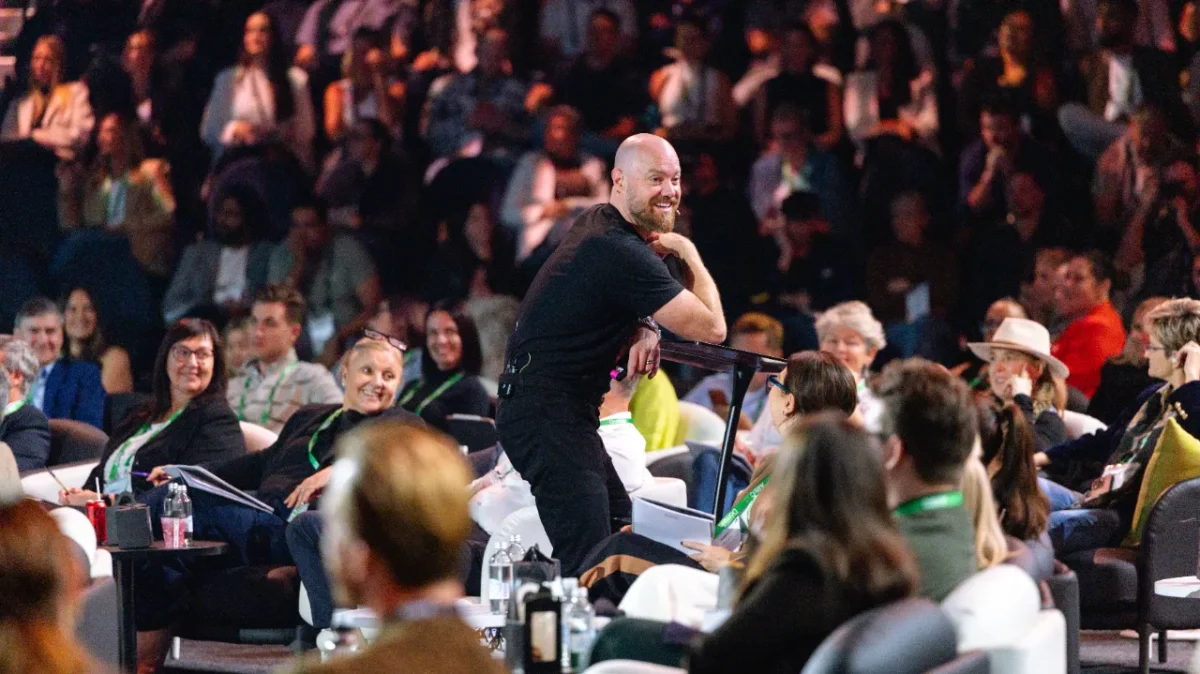
Phill Nosworthy opened with a quote from Jung: “The answers we most seek will be found in the places we are least prepared to look.”
The leadership consultant – who works with teams at Microsoft, Xbox and Formula One – told the AREC audience that there’s a threshold in every career where learning more about your own craft stops producing breakthroughs. The real growth comes from outside your domain.
He brought three insights to make the point.
Slow down to speed up
Nosworthy shared a conversation with McLaren’s Zak Brown at a private gathering hosted by the Australian Grand Prix Corporation. The topic was winning, and Brown’s answer surprised the room.
“The fastest car on race day Sunday is not the car with the biggest engine,” Brown told them.
“It’s the car with the best brakes.”
The logic: a driver who puts their foot on the accelerator and never lifts will be off the track within a lap. The car that wins is the one that can accelerate and decelerate the fastest – finding the right line through every corner.
Nosworthy carried the metaphor into leadership. Agents who only know how to accelerate burn the engine, burn the car, or crash. Slowing down isn’t weakness – it’s how you reposition to speed up again.
He extended this into what he called “speed to certainty” – the instinct to have an answer for every question. A former CEO he worked with pulled him aside early in his career and said something that stuck.
“I’ve never heard you say ‘I don’t know,'” she told him.
“If you’ve got an answer for every single question, it makes me doubt everything you say.”
See boundaries as shared spaces, not barriers
Nosworthy used Microsoft’s transformation as a case study. Fifteen years ago, the company was a roughly $200 billion organisation with a culture famous for internal hostility – teams aggressively opposed to each other, protecting territory rather than sharing expertise.
Under Satya Nadella, Microsoft grew into one of the world’s most valuable businesses.
The biggest shift wasn’t product or distribution. It was culture – treating the boundaries between teams’ work as the start of shared spaces rather than barriers to defend.
Nosworthy introduced two concepts.
The first is “expertise variety” – the strongest teams have people with different skills, backgrounds and perspectives. The second is “mutual value recognition” – the ability and willingness to recognise, seek out and act on the expertise of others.
“You could have all the expertise variety in the world,” he said, “and unless you have mutual value recognition, you will never get the value from it.”
He tied it back to the story of Great Ormond Street Hospital, where the world’s best paediatric surgeons were losing children during handovers between surgery and intensive care.
They found the answer not in medicine but in Formula One pit stops – and reduced technical errors by fifty percent.
The surgeons were skilled, but their results were fragile because expertise and information didn’t flow smoothly among team members.
Run two clocks
Nosworthy’s final insight came from Microsoft’s development of the Majorana One quantum chip – twenty years of investment through three CEOs, the GFC and COVID.
“Great leaders run two clocks,” he said.
The short-term clock manages the quarter, the week, the deal in front of you. The long-term clock holds your biggest ambitions in view.
“Have you ever seen a leader chase the quarter and lose the year?” he asked.
“Have you ever seen a leader land the sale in front of them, but do it in such a way that cost them the next brief?”
The discipline is holding both at once – short-term execution matched with long-term vision. Neither can exist without the other.
Today’s to-do list
- Identify one problem in your business you keep trying to solve with real estate knowledge. This week, look for the answer somewhere else entirely – a podcast about hospitality, a conversation with someone in tech, a book from a completely different industry.
- Audit your speed to certainty. In your next team meeting, when someone asks a question you’re not sure about, say “I don’t know” instead of reaching for an answer. Notice how it changes the conversation.
- Look at your team. If everyone has the same background, skills and perspective, you have low expertise variety. Identify one gap and think about who could fill it – even informally.
- Map the handover moments in your client process – the transitions between listing and marketing, between negotiation and settlement, between you and your support team. Where does information get lost? That’s where your fifty percent improvement is hiding.
- Write down your two clocks. What’s the deal or goal you’re chasing this quarter? And what’s the thing you want to have built in five years? Check whether the first clock is helping or hurting the second.