

The Federal Budget decision to strip negative gearing benefits from established residential properties has triggered an obvious immediate slump in housing finance, setting up a sharp rebalancing across Australia’s property market as investors retreat.
Data following the May 12 announcement shows new investor loan commitments dropped 8.6 per cent in the June quarter, while total lending values fell 10.2 per cent.
Because the policy came into effect mid-way through the quarter, the full extent of the contraction is expected to be even larger in coming months.
Ray White Group Chief Economist Nerida Conisbee said the loss of tax write-offs leaves private landlords facing a fundamentally altered market, forcing yields to rise through higher rents, softer house prices, or a combination of both.
“The question is what would make property financially attractive to investors again,” she said.
“This can happen through higher rents, lower prices, or most likely, a combination of both – something which is already occurring.”
Data from Cotality shows average gross rental yields across Australian capital cities sat at 3.95 per cent in July 2026; standalone houses yielded 3.37 per cent compared to 4.76 per cent for apartments.
Ray White analysis indicates an investor using an 80 per cent loan-to-value ratio at a 6.5 per cent interest rate now requires a gross yield of roughly 5.15 per cent to offset the removal of negative gearing. A higher yield of 6.5 per cent is required for a property to become cash-flow neutral on a pre-tax basis.
Ms Conisbee said reaching those revised benchmarks does not mean rents or home values must carry the entire load in isolation.
“Rental yield is simply rent relative to the value of the property,” she said.
“Higher rents lift the yield. Lower property values also lift the yield. In practice, the adjustment can occur through any combination of the two.”
If property prices remain unchanged, rents nationwide would need to jump 30 per cent to hit the 5.15 per cent survival hurdle, or rise 65 per cent to reach the 6.5 per cent self-funding threshold.
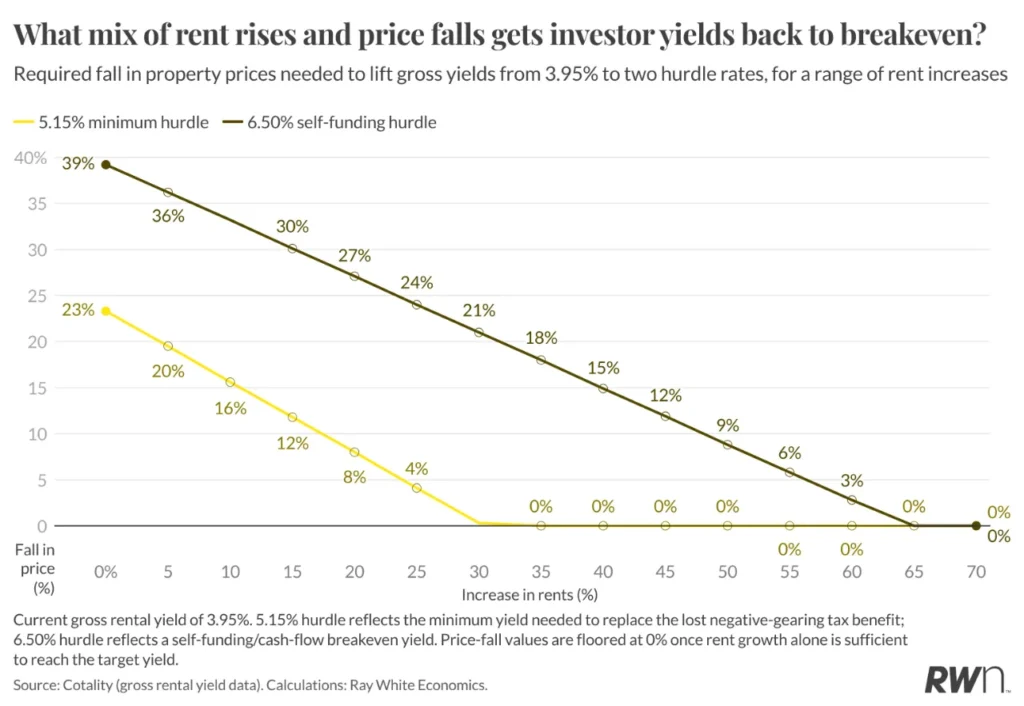
Conversely, a 10 per cent rise in rents reduces the required property price fall to around 16 per cent to hit the baseline hurdle.
A 20 per cent rent surge lowers the necessary price correction to 8 per cent, while a 30 per cent rent rise eliminates the need for price drops entirely.
Starting yields vary significantly across capital cities, meaning the local impact will differ widely. Sydney and Brisbane face potential price falls of 28 per cent and 32 per cent respectively if rents hold flat.
Melbourne (4.58 per cent yield) and Canberra (4.80 per cent yield) require much smaller adjustments, while Darwin – boasting a 6.44 per cent yield – already sits above the minimum threshold.
Ms Conisbee said market forces will ultimately drive the necessary yields through shifts in both supply and buyer demand.
“Slower growth in rental supply supports rents, while softer investor demand can moderate prices,” she said. “Together, those movements lift rental yields and gradually improve the investment equation.”