
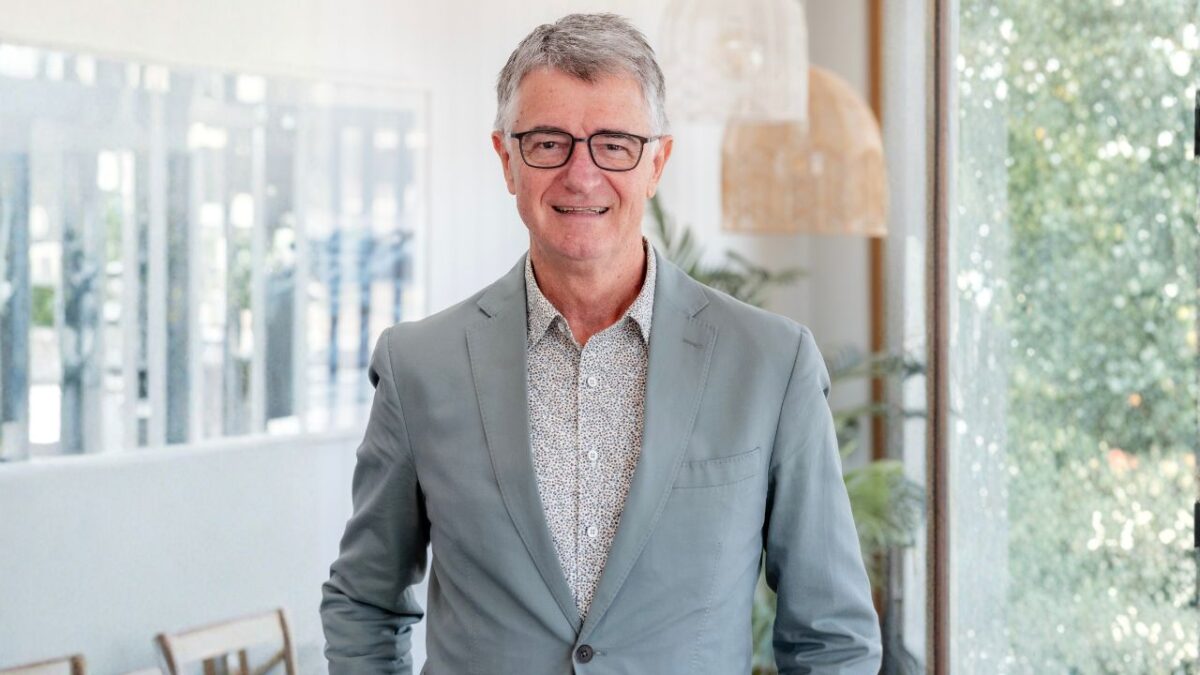
John Cunningham believes he could have built a real estate business 10 times the size of the one he leads today, but somewhere along the way, he decided that the pursuit of growth was less important than the kind of business he wanted to spend his working life building.
For the Managing Director of Cunninghams Real Estate, success has never been exclusively about expanding his footprint across Sydney’s Northern Beaches or increasing transaction volumes, but about creating an environment where people genuinely want to work together and where professional ambition doesn’t come at the expense of personal wellbeing.
“We could be 10 times bigger than we are, but we chose not to be,” John says.
“We chose to enjoy working with the people we like to work with, and live a life.”
When John and his wife Anne established the independent agency in 1991, Australia was experiencing a recession, and rather than adopting the conventional real estate business model, they saw an opportunity to challenge many of the practices they had encountered throughout their careers.
“At the time, we didn’t know it was called culture back in the early nineties,” he says.
“We just called it, let’s have a great work environment. That’s where it all started, and that’s something that we’ve maintained as an ethos and a part of our DNA.”
Thirty-five years later, the business has 15 partners across different areas of its operations, with some employees having remained with the agency for more than two decades and a couple exceeding 30 years.
For John, that longevity begins with recruitment and, more specifically, understanding what prospective employees want from their lives before considering what they might achieve professionally.
“I’ve always taken the view that there’s more to this career than just a career. There’s a life that goes with it,” he says.
“Even that interview process is finding out what people want from their life. And it’s not just, I want to make a million bucks. That’s not the answer to what their life might be.
“It might actually provide them with things in their life. But if they let life disappear along the way because all they’re doing is working, they really haven’t had a life.”
Finding an alternative to hustle culture
In a profession characterised by financial pressures, long working hours and emotionally demanding client interactions, John believes agency principals have a responsibility to create an environment that allows people to perform without operating in a constant state of stress.
Rather than encouraging employees to adopt an aggressive approach to achieving their goals, he sees leadership as a process of helping people move from uncertainty to clarity, developing the confidence and curiosity they need to make better decisions independently.
“The leader’s job or the leader’s role is to provide them with clarity and then to create a calm environment in which they can thrive,” he says.
“Calm is an incredible state. That’s like the ultimate goal of people, but a lot of people just simply don’t know how to get there.”
That sense of composure becomes particularly important when dealing with buyers and sellers who are themselves experiencing uncertainty, with John questioning whether the high-energy, relentlessly competitive approach often associated with real estate is necessarily what clients want from their agent.
“It’s not this brash, brazen, hustle grind type thing,” he says.
“We don’t see it that way. We see there’s another path to success.”
An important component of that philosophy is psychological safety, which John believes gives employees the confidence to ask questions, acknowledge gaps in their knowledge and seek assistance without feeling that doing so will compromise their standing within the business.
“They can always ask questions. They can always get answers. They can always get guidance, and they can see a clear path that’s being created,” he says.
“It’s how we work together gives a culture life.”
Creating a supportive workplace, however, doesn’t mean removing accountability, and John draws a distinction between employees who make mistakes and learn from them and those who consistently look elsewhere for someone to blame.
“And if they stuff up, it’s okay. There’s only one question that’s asked, is, well, what did you learn from that?” he says.
“You’ll learn something, and you’ll grow as a result of that because failure is just a series of learnings.”
One of his frustrations with traditional real estate training is that businesses often prioritise technical competencies such as prospecting, listing presentations and negotiation before considering whether the individual has developed the self-awareness and personal attributes required to apply those skills effectively.
“You’ve got to see that personal development precedes professional development,” John says.
“People in this industry go straight into the skill side of it without actually understanding the human behind it.”
When a difficult market exposes the cracks
Despite the longevity of many of his employees, John is candid about the challenges of maintaining a healthy workplace in a commission-based industry, acknowledging that even businesses with clearly established values can find themselves tolerating behaviour that is detrimental to the wider team.
“We’ve had people that have been toxic. We’ve had people leave us that we were glad that they left,” he says.
“And did sometimes we put up with bad behaviour for too long? Yes, we did.”
The current property downturn has brought some of those issues into sharper focus, with John observing that difficult trading conditions can expose an individual’s willingness to adapt, take responsibility and contribute to the collective efforts of the business.
For agency principals, the challenge is recognising when an employee needs additional guidance and when their behaviour is fundamentally at odds with the culture the business is trying to maintain.
“I mean, we’ve just had a bit of a cleanse in the last two months, which has been really interesting when people haven’t been able to handle the changed market,” he says.
“They’re looking for excuses, for blaming everyone else for what’s going on.
“This is a market where you have to stand up and be counted, this is a market where you have to know that, one, you have to work harder, and two, you have to work smarter.”
John sees parallels between today’s challenging conditions and those he encountered when establishing Cunninghams in 1991, when the decision to abandon many of the industry’s established practices helped the fledgling business find its footing.
“This is the time to break new ground, which is what we did in ’91,” he says.
“I threw out the playbook and started again in a completely different way, and we thrived.”
For younger agents who have built their careers during more favourable market conditions, the current downturn presents an opportunity to develop skills that may not have been tested when properties were selling quickly and securing business was comparatively straightforward.
Cunninghams currently has a development group of seven emerging agents, and John has encouraged them to view the next year as an investment in their long-term careers rather than simply a difficult period to endure.
“I said to them all, guys, if you get through this next year, you’re going to have amazing careers because you’ve learned stuff the hard way,” he says.
“Right now, everything requires high-level skill, high levels of patience, high levels of understanding, high levels of creativity to create deals.”
Those demands extend well beyond the sales team, with John pointing out that declining transaction volumes do not necessarily translate into a reduced workload for the employees responsible for marketing, administration and operations.
As properties remain on the market for longer, the work involved in supporting each campaign can increase, placing additional pressure on the people whose contributions are perhaps less visible than those of the selling agents.
“They’re actually handling more stock and less sales, but their workload’s massive because there’s more stock,” he says.
“The engine room’s actually working harder and harder.”
This is where John believes staff longevity becomes a genuine commercial advantage, not only because of the costs associated with recruitment and turnover, but because experienced employees can provide continuity for clients while helping newer team members navigate unfamiliar market conditions.
“People do have their highs. They have their lows. They fall back on old habits sometimes when things are tough,” he says.
“And it’s the leader’s job to help guide them through that.”
John says Cunninghams has increased its market share during the current downturn, with its transaction volumes declining less than those of its broader marketplace, something he attributes in part to the reputation the business has established over several decades.
“We thrive when markets are tougher, because we’re also seen as, I suppose, a safe bet,” he says.
“We much prefer to under-promise, over-deliver, than to over-promise and under-deliver.”
Building a business that can succeed beyond its founder
Perhaps the most significant change in John’s leadership journey came when he recognised that continuing to be the agency’s leading salesperson was no longer necessarily the best contribution he could make to the business.
In its formative years, he describes himself as a captain-coach, simultaneously listing and selling property, overseeing the agency’s finances, running its operations and developing the people around him.
While that approach was effective in establishing the business, stepping away from selling gave him the opportunity to concentrate on developing other leaders and creating a structure that was less dependent on his individual performance.
“As soon as I stopped selling real estate, the business grew significantly because I focused on leadership and growth, and getting the best out of people and empowering people,” he says.
“I love that expression, empowering leadership, because when you let go to grow, you see things happen beyond you.”
Although his surname remains prominently displayed on signboards across the Northern Beaches, John no longer considers the brand an extension of his personal identity, a distinction that can be particularly difficult for independent agency owners whose businesses have been built around their individual reputations.
“It’s funny that my name’s everywhere on signs or whatever it may be, but I don’t relate that brand to me as a person. It’s now beyond me,” he says.
“That’s something that I’ve created that has its own life now.”
That transition has also influenced how John selects the people who become partners in the business, with leadership appointments determined by more than an individual’s ability to generate revenue or consistently achieve strong sales results.
“To become a leader in our business and to become a partner, you have to exemplify those leadership attributes. You have to live them,” he says.
“You’ve got to put the business above you. You’ve got to put the people above you.
“And some people just couldn’t get there, and therefore they didn’t become partners because that’s something we treat seriously.”
The agency has formalised its philosophy through the Cunninghams Way, which documents expectations around employees’ conduct and working practices, alongside an internal wellbeing framework known as Cunninghams Care.
John says the business recently received the Real Estate Institute of NSW’s inaugural wellbeing award, but for him, the underlying objective is to help employees develop a stronger sense of purpose and understand how their individual contributions fit within the wider organisation.
He encourages people to consider three questions about how they approach their working day.
“Who am I being today? Then how am I being seen? And then what am I going to achieve?”
By encouraging employees to think beyond their immediate responsibilities, John hopes to move away from the siloed working environments that can develop in real estate, particularly when individual performance is rewarded without sufficient consideration of how people contribute to the success of their colleagues.
“When we have that one team, one standard, and one experience, it has meaning to people,” he says.
“And I think there’s a big lack of meaning in this industry, purpose. And I think if we can have that within our wellbeing, our longevity, our workplace culture, and it all stems from really great leadership.”
For agency principals, John’s experience raises a broader question about what they ultimately want their businesses to achieve, particularly in an industry where expansion, recruitment and individual sales performance are often treated as the most visible indicators of success.
After 35 years, his ambitions remain closely connected to the lives his employees are able to lead, the relationships they have developed and the opportunity to build something that will continue to succeed independently of him.
“I’ve hopefully created a place that people want to stay, play, and perform,” he says.
“And again, it’s just more about the lives they can lead as a result of that.”