
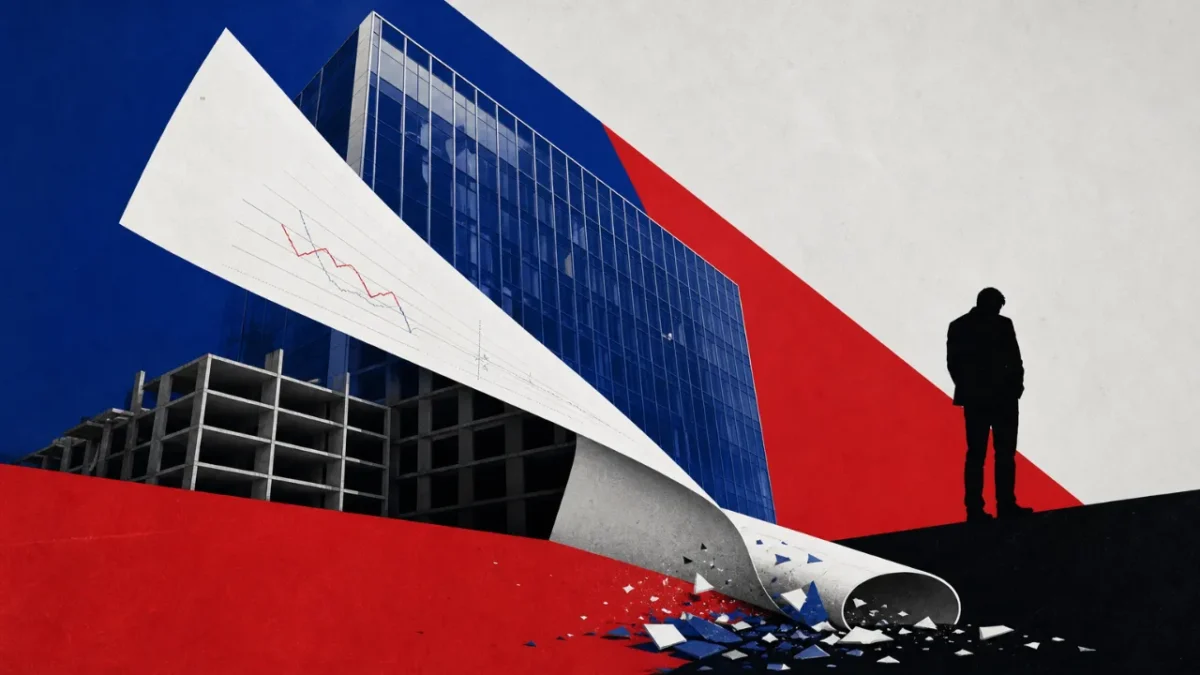
Hui Ka Yan, the man who built China Evergrande Group into the country’s largest property developer before it collapsed under $US300 billion ($420 billion) in liabilities, has been sentenced to life in prison by a court in Shenzhen.
The Shenzhen Intermediate People’s Court found that between 2016 and 2021, Hui had “violated state laws by employing methods such as sustained, large-scale financial fraud to inflate assets and conceal liabilities,” according to the Guardian. The court said his conduct had “severely disrupted the order of the socialist market economy” and “caused exceptionally heavy economic losses”.
Hui, 67, pleaded guilty in April to eight charges including misuse of funds, fundraising fraud, illegally taking public deposits, illegally extending loans, fraudulently issuing securities and bribery. The court ordered all of his personal property confiscated, effectively reducing his net worth to zero.
More than 50 other people linked to Evergrande were also sentenced, with prison terms ranging from 20 months to 18 years. That group included Hui’s sons, Xu Zhijian and Xu Tenghe, who received jail terms of between 18 and 22 months, news.com.au reported.
Evergrande Group was fined 8.82 billion yuan ($1.85 billion) and its property arm, Evergrande Real Estate Group, was fined 7 billion yuan ($1.45 billion), according to ABC News.
Investigators found Evergrande had booked revenue from apartment sales before the properties were built or delivered, overstating revenues by roughly $US80 billion ($112 billion) across 2019 and 2020 alone, the ABC reported.
News.com.au put the inflated revenue figure at $A110 billion, with more than $A420 billion in liabilities concealed from banks and investors.
Evergrande’s 2021 default, triggered when Beijing introduced borrowing limits for developers under its “three red lines” policy, (a set of strict financial rules introduced by the Chinese government in August 2020 to control and reduce the massive debt in the country’s real estate sector), left 1,300 projects unfinished and millions of buyers paying mortgages on homes that were never completed.
Former RBA economist Martin Eftimoski told news.com.au the roots of the crisis trace back further.
“The bubble in real estate in China really began as a response to the GFC,” Martin said.
“To save the economy, they overstimulated the real estate market. A lot like the (Coalition government’s 2020) HomeBuilder policy.”
He said the fallout has hit household wealth hard, given how heavily Chinese families relied on property.
“Most of the middle class in China stored their wealth in real estate, and when I mean stored their wealth, I mean their whole wealth,” Martin said. “Its collapse has crushed their consumer confidence and is a major contributor to deflation there, and civil unrest.”
The ABC noted that China’s property market is now undergoing a shift from speculative growth into what it described as a permanent “stable contraction”, with the sector adjusting to no longer being the country’s primary source of household wealth.
The slowdown carries a direct line back to Australia. China remains the largest buyer of Australian iron ore, and the Department of Industry, Science and Resources forecasts export earnings from the commodity will fall from $116 billion in 2024–25 to $107 billion in 2026–27.
This story draws on reporting from ABC News, the Guardian and news.com.au