
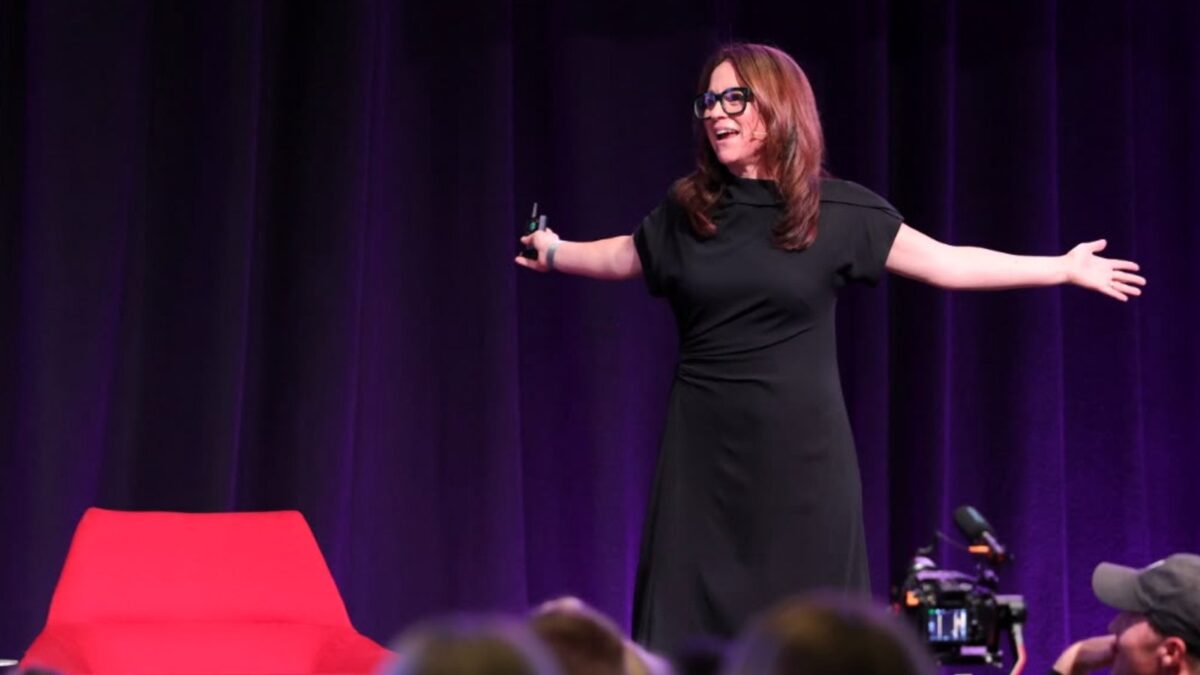
Fiona Blayney opened PM/ONE 2026 at the Hilton Sydney with a story about Coke and a warning for property managers: the industry has spent years training landlords to measure its worth by counting tasks, and that model is running out of road.
Speaking on day one of the conference, the REAL+ founder said the sector was at a pivotal point.
“Right now in our industry, I actually don’t think there has ever been a more exciting yet scary time to be in PM,” Fiona said.
Fiona used the price of a can of Coke – ranging from $4.70 at a supermarket to $13 from a hotel minibar to $5 at a restaurant – to illustrate that customers pay for perceived value, not the product itself.
She argued property managers have failed to apply the same thinking to their own fees, instead leaning on volume metrics such as the number of properties managed, routines completed, or rent reviews processed.
“We have trained our clients to measure our success and our value based on the completion of tasks that we do,” Fiona told the room, adding that landlords don’t actually care how many tasks are performed, only that the work gets done and returns are protected.
She pointed to prescribed application forms and increasing legislative uniformity across states and territories as evidence that many PM tasks are becoming commoditised.
Layered on top of that, Fiona said, is the growing capability of AI tools to automate much of the transactional workload property managers currently bill for.
Fiona told delegates she had used ChatGPT to build a full self-managed landlord operating system, complete with dashboards for maintenance, lease renewals, compliance and rent receipting, in a matter of hours.
She also noted that 31 per cent of searches are now conducted via a large language model rather than Google, underscoring how quickly consumers and agents are adopting automated tools.
Despite that, Fiona said two things remain outside a bot’s reach: presence and judgment.
“What it doesn’t have is these two most magnificent human qualities… that they cannot take away from us with a bot, and that is presence and judgment,” she said.
She illustrated the point with an example from a friend’s rental portfolio, where an automated comparative market analysis had recommended raising all five properties to $450 a week, ignoring that two of the units were unrenovated.
Fiona said a tenant in one of those properties immediately queried the increase after seeing a renovated unit in the same block renting for the same price, a scenario she said only human judgment could have avoided.
Fiona’s practical takeaway for PM leaders was to change how they communicate with landlords, replacing task-based updates with explanations of outcomes and reasoning.
Rather than telling an owner a lease renewal has been completed, Fiona suggested framing it around the vacancy risk avoided, the dollar impact on annual return, and the reasoning behind any pricing recommendation.
“You’ve been providing value this whole time,” she said.
“You’ve just never told it this way.”
Fiona told delegates the sessions across the remainder of PM/ONE, running through to Monday 14 September, would focus on helping property managers build exactly that: the judgment and presence needed to make their value visible to clients.
Actionable
- Rewrite your KPIs around outcomes, not task counts: track vacancy avoided, rent uplift and ROI per portfolio, not routines and renewals completed.
- Put outcomes on your CV and your agency’s pitch: average portfolio revenue growth per year, not doors managed.
- Every time you finish a task, tell the owner three things: what you did, what it meant, and why it mattered.
- Turn the lease renewal notice into a value statement: “we cut your vacancy risk by 50 per cent and lifted your annual return by X”, not “your renewal is complete”.
- Check every automated CMA or rent review with your own judgment before it reaches the owner: the bot doesn’t know which unit is renovated.