
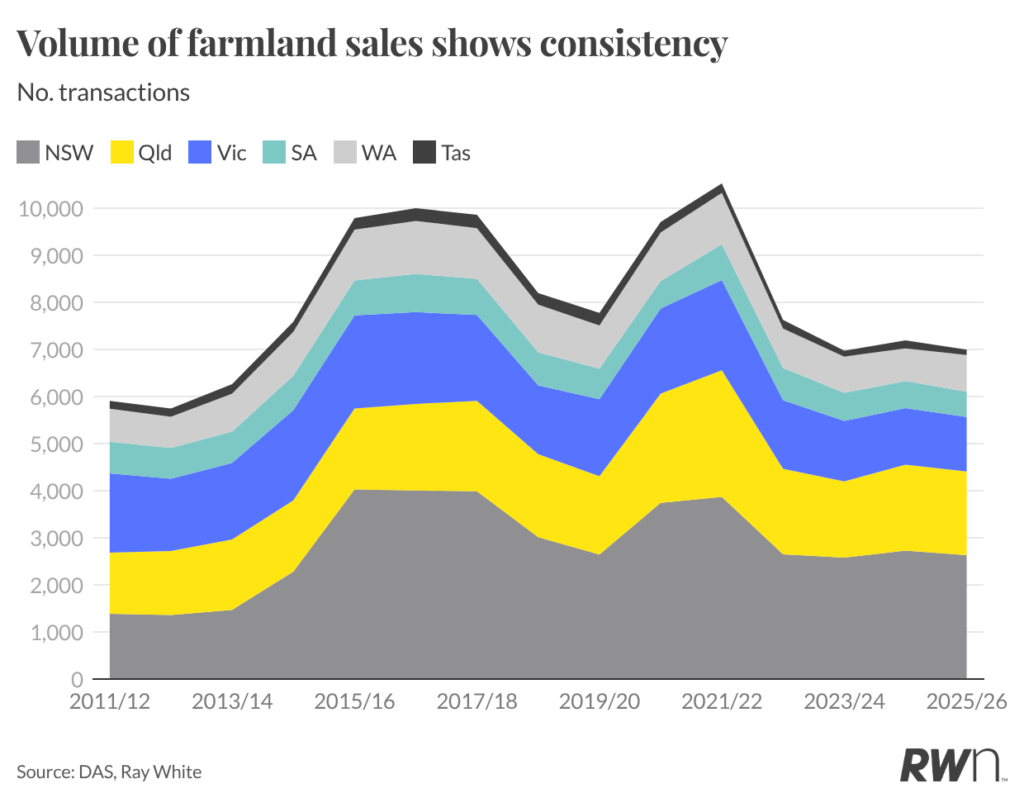
Australian farmland recorded 6,988 transactions in 2025/26, a 2.8 per cent decline on the previous year, according to Ray White Group’s Head of Research, Vanessa Rader.
It is the third consecutive year national sales have held close to the 7,000 mark, a third below the 2021/22 peak of more than 10,500 sales.
Ms Rader said the consistency of activity over the past three years points to a market that has found its level, with land tightly held and owners largely choosing to sell on their own terms rather than under pressure.
New South Wales continued to lead activity with 2,631 sales, or 37.7 per cent of the national total, followed by Queensland with 1,772.
Western Australia was the only state to lift volumes, rising 12.1 per cent to 778 sales, while Victoria (1,157) and South Australia (536) both recorded their lowest annual totals in more than 15 years.
Tasmania saw the sharpest pullback, with sales falling by a third to just 114, the lowest result in the series, meaning values in the island state are now being set by a very small number of transactions.
On values, the year belonged to Western Australia and Queensland. Western Australia lifted 13.5 per cent to $8,567/ha, while Queensland rose 12.3 per cent to $9,891/ha, supported by strong cattle prices that have kept cash flow healthy for grazing businesses and sustained demand for well-watered country.
Over the past five years both states have close to doubled in value, with Western Australia up 96.6 per cent and Queensland up 89.3 per cent, outpacing every other state.
Victoria remains the highest priced mainland state at $15,577/ha, up 3.8 per cent over the year, as a turnaround in seasonal conditions and strong rainfall across much of the south lifted confidence after successive dry years.
South Australia benefited from the same change in fortunes, edging 1.4 per cent higher to $9,757/ha as growers positioned for a strong winter crop.
New South Wales eased 2.4 per cent to $9,964/ha, its first annual decline since 2013/14.
Dry conditions across the north of the state, rising input costs and a widening gap between vendor and buyer expectations have seen properties remain on the market for longer.
As a result, NSW, Queensland and South Australia now sit within $210/ha of each other, all close to the $10,000/ha mark.
Tasmania, still home to the country’s most expensive farmland at $24,684/ha, fell 6.4 per cent and now sits 10.7 per cent below its 2023/24 peak, with dry conditions and buyer caution weighing on activity.
Across the country, quality continues to drive results, with blue chip holdings and neighbouring parcels attracting strong competition while secondary and marginal country takes longer to sell.
Ms Rader pointed to higher interest rates, fuel and fertiliser costs, and uncertainty around capital gains tax reform as factors making it harder for many farm businesses to justify another purchase at current values, with leasing and share farming increasingly used to build scale.
“Livestock remains the standout support for the sector, with elevated cattle and sheep prices underpinning grazing land values across much of the country, while the grain price outlook has improved through spring,” she said.
“Looking ahead, values are expected to continue lifting through the remainder of 2026 as harvest cash flow flows through to the southern cropping states and livestock markets remain firm. The outlook into 2027 is more measured, with El Niño conditions raising the likelihood of a drier season across agricultural regions and further rate rises possible.”
For buyers and sellers alike, she said the market is likely to remain selective, rewarding quality, location and water security over broad-based growth.