

Australia’s housing market has recorded its steepest quarterly house price decline on record, with prices falling across all eight capital cities for the first time in 15 years as weaker buyer confidence, higher borrowing costs and mounting affordability pressures reshape selling conditions.
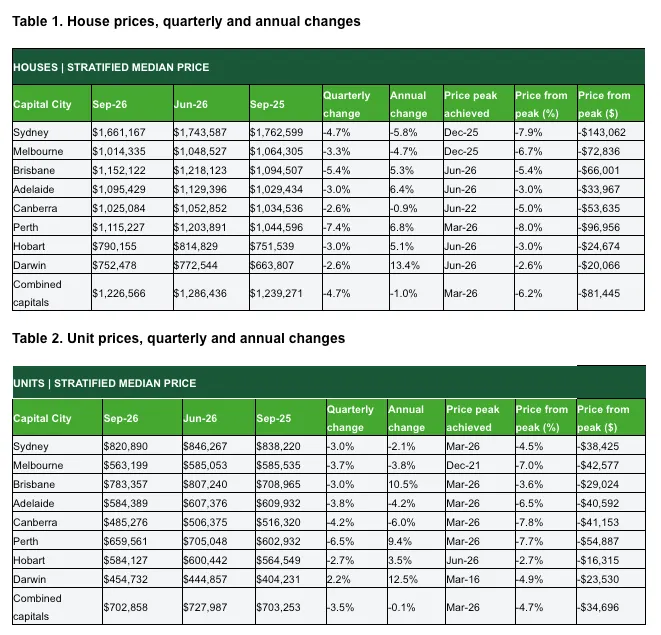
Domain’s September Quarter 2026 House Price Report reveals combined capital city house prices fell 4.7 per cent, or $59,870, over the three months to September, taking the median to $1,226,566, while unit prices declined 3.5 per cent, or $25,129, to $702,858, their steepest quarterly fall in seven and a half years.
It marks only the second time on record that house prices have fallen simultaneously across every capital city, with the latest downturn extending well beyond Sydney and Melbourne to markets such as Perth, Brisbane and Adelaide, which had previously been among the country’s strongest performers.
The figures also represent the second consecutive quarter of falling house and unit prices, with annual growth across the combined capitals turning negative for the first time in more than three years.
The report points to a substantial change in selling conditions, with longer campaigns, increased discounting and subdued auction clearance rates shifting negotiating power towards buyers, while some vendors are reconsidering their price expectations or moving from auction to private treaty campaigns.
Domain Chief Residential Economist Dr Nicola Powell said the September quarter represented a significant turning point for the housing market.
“Australia’s housing market has entered a new phase in the downturn. What began as weakness concentrated in some cities has broadened considerably, with house prices now falling across every capital for the first time in 15 years.
“Confidence has become one of the market’s biggest headwinds. Higher interest rates and persistent cost-of-living pressures are reducing how much buyers can borrow and their willingness to transact. When buyers expect prices could fall further, there is less urgency to act and greater incentive to wait.”
The sharpest quarterly decline occurred in Perth, where house prices fell a record 7.4 per cent, or $88,664, to $1,115,227, representing a dramatic reversal for a market that had enjoyed sustained price growth.
Perth unit prices also recorded their largest quarterly fall on record, declining 6.5 per cent, or $45,487, to $659,561, although both houses and units remain above their September 2025 levels, highlighting how quickly the market has changed.
Brisbane house prices fell 5.4 per cent, or $66,001, to $1,152,122, ending almost four years of uninterrupted growth, while Adelaide’s median declined 3 per cent, or $33,967, to $1,095,429, bringing more than three and a half years of consecutive quarterly gains to an end.
Adelaide’s result matched its March 2009 decline as the steepest quarterly fall on record, while Brisbane also recorded a historically significant reversal.
Dr Powell said the change in fortunes for the previously strong markets demonstrated that affordability constraints and weaker sentiment were now affecting cities that had been relatively resilient.
“It’s a significant reversal for Perth, Brisbane and Adelaide. These were among the strongest markets of the previous growth cycle, but affordability constraints and weaker sentiment have caught up with them, resulting in some of the sharpest quarterly falls on record.”
Sydney’s median house price fell 4.7 per cent, or $82,420, to $1,661,167, marking its steepest quarterly decline in four years and its third consecutive quarter of falling prices.
The city’s house prices are now at a two-year low, sitting 7.9 per cent, or $143,062, below their December 2025 peak, while the annual decline of 5.8 per cent was the largest recorded across the capital cities.
Melbourne recorded its third consecutive quarterly house price decline, with the median falling 3.3 per cent, or $34,192, to $1,014,335, leaving the city increasingly close to slipping below the million-dollar threshold it first crossed in June 2021.
House prices in Melbourne are now 6.7 per cent, or $72,836, below their December 2025 peak, while annual growth has turned negative for the first time in 18 months, with prices down 4.7 per cent compared with September last year.
Elsewhere, Canberra house prices fell 2.6 per cent to $1,025,084, their steepest quarterly decline in three and a half years, while Hobart’s median dropped 3 per cent to $790,155, ending five consecutive quarters of growth.
Darwin also recorded a 2.6 per cent house price decline to $752,478, bringing almost two years of growth to an end, although the Northern Territory capital continues to lead the country for annual house price growth at 13.4 per cent.
The downturn has also spread further into the unit market, where prices declined in seven of the eight capitals, despite apartments generally remaining more affordable than detached houses.
Canberra unit prices fell 4.2 per cent to $485,276, their lowest level in almost five years, while Melbourne recorded a 3.7 per cent decline and Adelaide a 3.8 per cent fall.
Sydney unit prices declined 3 per cent to $820,890, while Brisbane recorded an equivalent percentage fall to $783,357, although Brisbane units remain 10.5 per cent higher than a year earlier.
Darwin was the only capital to buck the quarterly trend, with unit prices increasing 2.2 per cent to $454,732, taking annual growth to 12.5 per cent.
“Units continue to show greater resilience because of their relative affordability, but the breadth of this quarter’s declines shows they are not immune to weaker conditions,” Dr Powell said.
Beyond the price movements, the report highlights an increasingly cautious buyer pool, with higher interest rates, persistent cost-of-living pressures and changes to housing investment tax policy weighing on confidence and borrowing capacity.
Investors are pulling back, while first-home buyers are contending with higher mortgage repayments and uncertainty over whether prices have further to fall.
At the same time, seasonally low listing activity and clearance rates, longer selling times and increased discounting suggest that weaker demand is changing the dynamics of property transactions, even without a substantial increase in available stock.
For agents, that means the challenge is no longer simply generating buyer interest but converting cautious purchasers into committed buyers while helping vendors adjust to a market in which previous price benchmarks may no longer reflect current conditions.
Dr Powell said buyers with secure finances were finding opportunities that had been difficult to access during the previous growth cycle, although vendors were increasingly being forced to confront the changed market.
“The balance of power has shifted towards buyers. Homes are taking longer to sell, there is greater scope to negotiate, and sellers are having to be more realistic about price expectations. For buyers with secure finances and the capacity to transact, that creates opportunities that have been difficult to find in recent years.”
The report suggests any sustained recovery will depend on improvements in both buyer confidence and borrowing capacity, with uncertainty surrounding interest rates, household expenses and housing policy continuing to influence purchasing decisions.
“The path to recovery will ultimately depend on both confidence and purchasing power. Until households have greater certainty around interest rates, living costs and policy settings, buyers are likely to remain cautious, and prices will remain under pressure.”