

Australia’s unemployment rate climbed to 4.9 per cent in October, with 43,500 jobs lost, prompting Ray White Group Chief Economist Nerida Conisbee to question whether the Reserve Bank’s November interest rate increase was one too many.
The latest labour market figures add to concerns about the strength of the economy, particularly as Australia’s housing market continues to record significant price declines and buyer activity remains subdued.
“Australia’s labour market is weakening more quickly than forecast, raising questions about whether the RBA’s November interest rate increase was one too many,” Ms Conisbee said.
While the headline unemployment rate reached 4.9 per cent, the longer-term figures also point to a deterioration in employment conditions. The proportion of Australians aged 15 and over who are employed has fallen from 64.4 per cent in late 2024 to 63.6 per cent, while the trend unemployment rate has increased to 4.8 per cent.
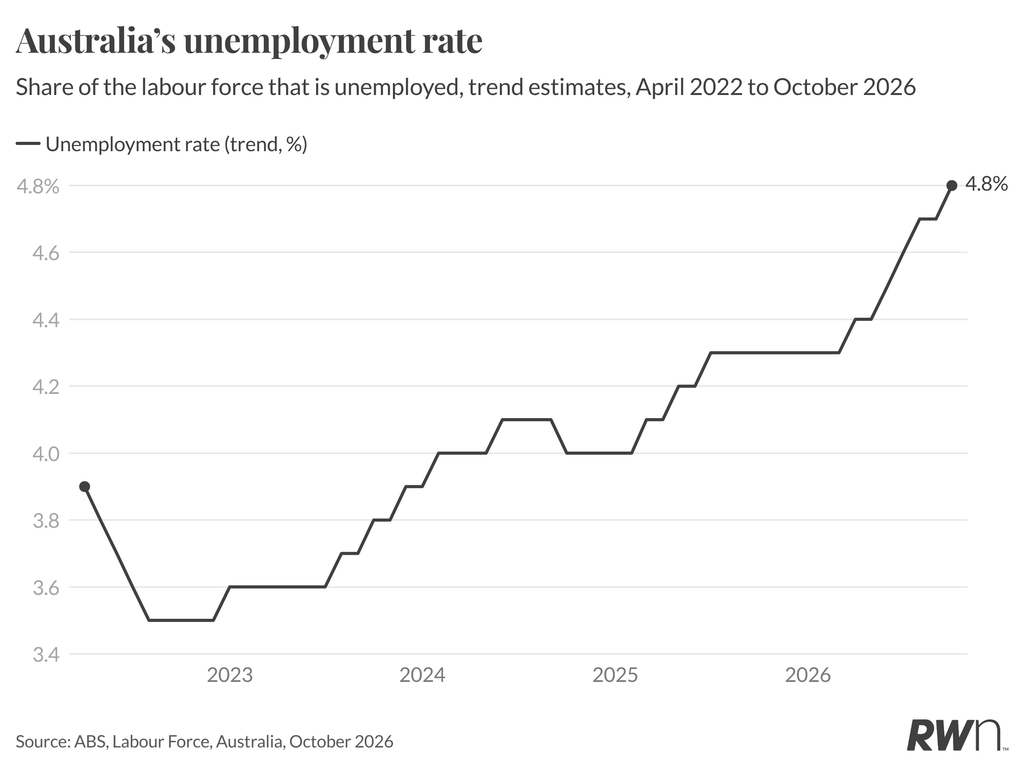
Ms Conisbee said the result was weaker than economists had anticipated, although the broader deterioration in employment conditions was not entirely unexpected.
“The result was weaker than forecast, although not unexpected. It makes further interest rate increases much less likely. Next week’s inflation figures will be critical in determining what happens next.”
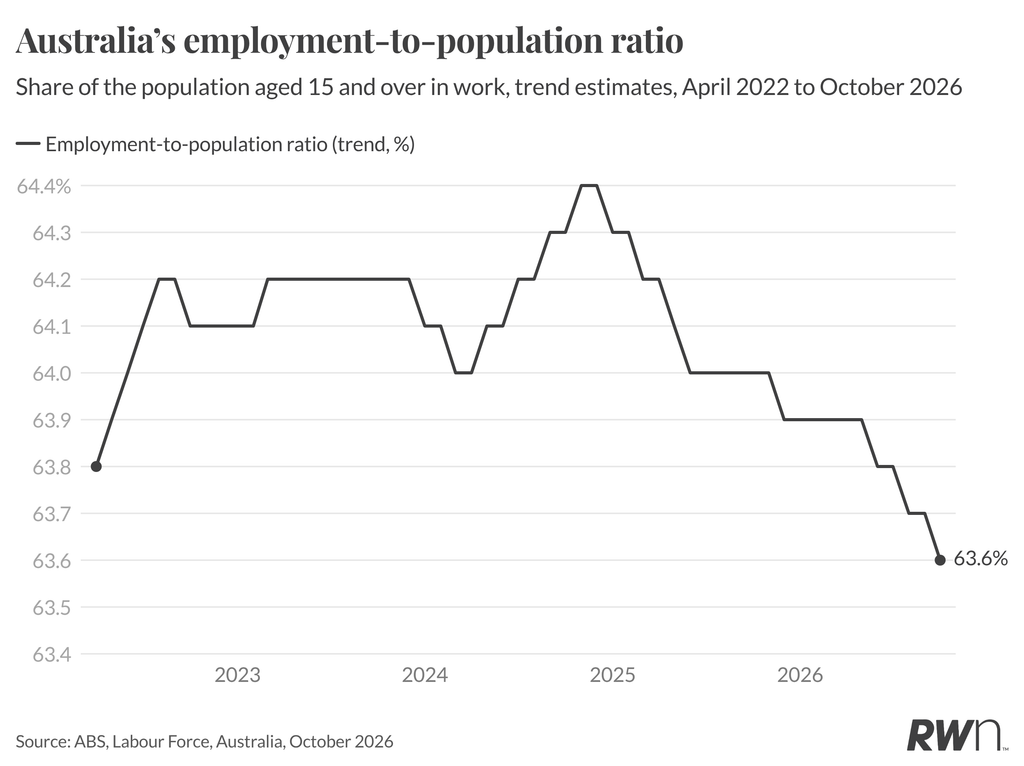
The figures come at a difficult time for the property market, where higher borrowing costs and declining buyer confidence have coincided with substantial falls in dwelling values across several capital cities.
Sydney and Melbourne lead property downturn
According to Cotality figures cited by Ray White, Sydney and Melbourne have recorded the largest annual declines in dwelling values, falling 9.4 per cent and 7.6 per cent respectively over the past year.
Melbourne’s downturn began in December 2025, while Sydney’s more sustained decline started in March 2026. However, the weakness has since spread to markets that had previously demonstrated greater resilience.
Ms Conisbee said the May Budget marked a turning point, after which price declines became more widespread across the country, including in Perth and Brisbane.
Since the end of April, Sydney dwelling values have fallen 9.2 per cent, followed by Perth at 8.9 per cent and Brisbane at 8.3 per cent. Melbourne has recorded a 6.3 per cent decline over the same period.
“The property market continues to show considerable weakness.”
The suburb-level figures also reveal considerable differences in how individual markets are responding to the downturn, reinforcing the importance of looking beyond capital-city averages.
In Sydney, the sharpest recent declines have been concentrated across the middle and outer south-west, particularly Canterbury-Bankstown, Fairfield and Liverpool. Annual price falls have been more widespread, extending into parts of northern Sydney.
Melbourne, however, is beginning to show signs of stabilisation in some of its more expensive suburbs, including South Yarra, Toorak and Hawthorn. Although dwelling values in these areas remain below their levels a year ago, recent movements suggest parts of the market may be approaching a floor.
The differences indicate that while the broader downturn remains firmly established, the timing and pace of any recovery are unlikely to be uniform across individual suburbs or capital cities.
Buyer activity remains subdued
Beyond falling prices, Ray White’s open-home figures suggest buyers are continuing to exercise considerable caution, with attendance levels declining sharply compared with a year earlier.
Across the four weeks to 14 November, attendance averaged just 1.76 people per inspection, approximately half the level recorded during the corresponding period last year.
Despite an increase in the number of inspections taking place, total attendance has fallen considerably, suggesting that additional opportunities to inspect properties have not translated into stronger buyer engagement.
“Our open-home data continues to show how cautious buyers have become. Attendance averaged just 1.76 people per inspection over the four weeks to 14 November, roughly half the level recorded a year earlier. Despite more inspections taking place, total attendance has fallen considerably,” Ms Conisbee said.
The figures highlight the challenge facing agents and vendors in the current market, particularly where sellers are still adjusting their expectations to reflect weaker demand.
For agents, subdued inspection activity reinforces the importance of realistic pricing, understanding local buyer conditions and recognising that the number of properties available for inspection does not necessarily indicate the strength of purchasing demand.
Could interest rate certainty bring buyers back?
Despite the weaker economic outlook, Ms Conisbee believes the prospect of interest rates having reached their peak could provide some support for the housing market.
While rising unemployment creates uncertainty around household incomes, employment security and consumer confidence, a clearer outlook for borrowing costs could encourage some buyers who have delayed purchasing decisions to reconsider their position.
“For the property market, a clearer interest rate outlook would be welcome. Rising unemployment is concerning for confidence and job security, but the prospect that interest rates have peaked is positive for prices,” she said.
Importantly, Ms Conisbee does not believe buyers necessarily need to see interest rates fall before confidence begins to improve.
“Buyers don’t necessarily need rates to fall before they return to the market. Greater certainty that borrowing costs won’t rise further could be enough to encourage some buyers back, particularly in markets where prices have already fallen substantially.”
The next inflation figures will therefore be closely watched, with the results potentially influencing expectations for the RBA’s next move.
For the real estate industry, the immediate challenge remains balancing the potential benefits of interest rate stability against the risks associated with a weakening labour market.
While an end to rate increases could improve borrowing confidence, rising unemployment may continue to weigh on household sentiment and purchasing decisions.
As Ms Conisbee’s analysis suggests, the direction of interest rates may prove increasingly important for the property market, but the strength of the labour market will also play a significant role in determining when buyers are ready to return.