

Sydney and Melbourne led the post-Budget housing downturn, but new data suggests sellers in both cities are now responding by holding back stock rather than flooding the market.
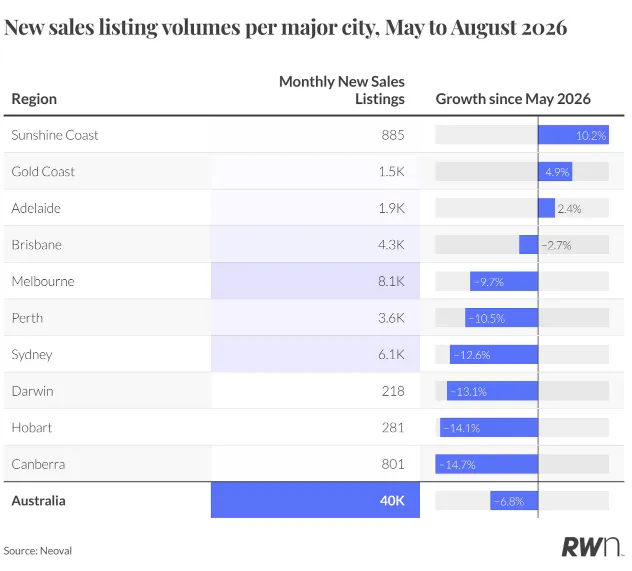
According to Ray White chief economist Nerida Conisbee, new listings fell 12.6 per cent in Sydney and 9.7 per cent in Melbourne between May and August, compared with a 6.8 per cent decline nationally. Canberra recorded an even steeper fall, down 14.7 per cent over the same period.
The pullback has flowed through to overall stock levels. Active listings – the total number of properties still available for sale, including those carried over from previous months – have dropped 5.6 per cent in Sydney and 7.4 per cent in Melbourne since May. Canberra has followed a similar pattern, with active stock down 7.5 per cent.
Ms Conisbee said the trend reflects owners choosing not to sell when conditions are weaker, rather than a lift in buyer demand absorbing existing stock.
“Housing supply is highly responsive to market conditions. Unless an owner needs to sell, they can delay putting their property on the market when prices are weaker or buyers become more cautious,” she said.
The picture in Brisbane and Perth is markedly different. New listings in those cities have also declined, down 2.7 per cent in Brisbane and 10.5 per cent in Perth since May.
But active listings have moved sharply higher, up 27.5 per cent in Brisbane and 20.2 per cent in Perth, indicating that existing stock is taking longer to sell rather than owners rushing to list.
Adelaide is showing a milder version of the same pattern, with new listings up 2.4 per cent and active listings up 15.0 per cent.
For agents in Sydney and Melbourne, the shrinking pool of stock represents a buffer against further price weakness, tightening the balance between buyers and sellers at a time when demand has already softened on the back of Budget changes and higher interest rates. But Ms Conisbee cautioned the outlook remains fragile.
“A further interest rate rise would reduce borrowing capacity and weaken buyer demand again,” she said.
Ms Conisbee said the divergence points to a housing market splitting into two distinct phases. Sydney and Melbourne, which experienced the earliest and largest weakness after the Budget, are now seeing sellers withdraw supply in response.
Brisbane and Perth, where conditions held up for longer, are instead grappling with a build-up of stock despite fewer new properties coming to market.
“After leading the initial downturn, Australia’s two largest housing markets are moving into a very different phase,” she said.