

After more than a decade as one of the leading agents at a major corporate real estate group where his team clinched the top sales team award across 41 offices two years running, Mark Josem decided to step away from the traditional corporate machine.
Long before entering property, Mark honed his commercial instinct by leading a national sales team of over 65 people within a business generating more than $250 million in annual revenue. That background shaped a sharp negotiation edge and an ability to move decision makers under pressure.
Yet, despite his stellar corporate career, a growing frustration with traditional real estate conventions led to the launch of Storyhouse Real Estate in Hawthorn East.
Built to service Melbourne’s blue chip Inner East, including Hawthorn, Camberwell, Kew, Canterbury, Glen Iris, Malvern, Armadale, and Toorak, the independent agency was built around the belief that homes seen by more, sell for more.
After more than a decade watching homes go through the same selling process – no matter the story, the buyers or the suburb – Mark Josem started asking a different question.
“Every listing I got inside a traditional corporate environment was put onto the conveyor belt of a cookie cutter model – photos, portals, opens, repeat, down the production line you go,” Mark says.
“It just didn’t allow my clients’ homes to stand out. I kept coming back to the same question: If it was my house, what would I want? The reality is I would want more creativity, more effort, and a campaign custom built for my home.”
Why Storyhouse built a different marketing model
While many traditional agencies treat social media and video as brand-awareness add-ons if at all, Storyhouse treats digital storytelling as a direct lead-generation and conversion tool.
Since launching, Mark says Storyhouse has generated 4.4 times more views on social media than traditional property portals across houses sold.
“Outside of the proven fundamentals you’d expect, our campaigns are designed to do more, so the vendor gets more.”
“Portals are the baseline; they catch the active searchers,” he says.
“Social media covers everything before, between, and during that search. It’s all about doing more, so the vendor gets more. And it’s working. One purchased 89 Broadway, Camberwell for $4,415,000 before it ever reached auction. They weren’t even searching the suburb. They found it on our Instagram.
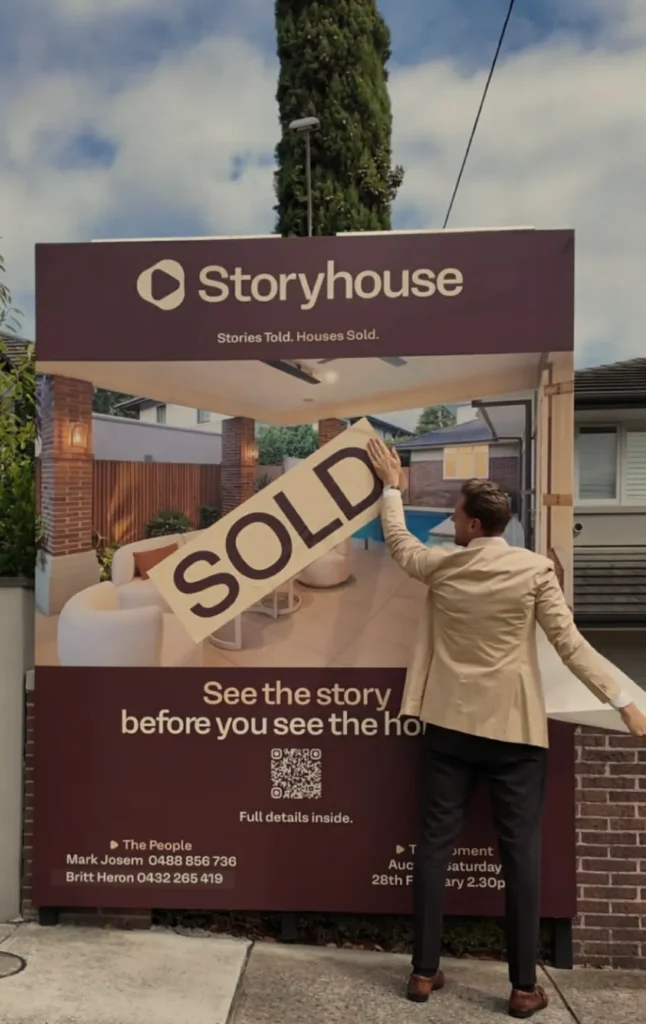
The key to turning casual scrollers into registered bidders isn’t about bigger budgets or cinematic polish – it’s about being authentic and having a system. Every Storyhouse campaign runs on the same framework: More Heart to build emotional connection, More Eyes to expand reach beyond the portals, and More Competition to convert that attention into buyer action.
“People scrolling on their phones are not looking for a corporate ad,” he says.
“When you strip away those rigid corporate rules, watch time goes up, and watch time is what drives true reach and engagement.”
That’s why every Storyhouse campaign is built around story-led content, designed to create connection before a buyer ever steps through the door – facts, features, and a third dimension: feeling.
“The way we see it, attention is the new economy, and authenticity is what earns it,” he says – a philosophy built on the belief that buyers don’t just see homes, but feel them, and what they feel determines what they’re willing to pay.
“Social media isn’t simply a marketing channel – it’s a commercial driver of buyer competition,” Mark says.
“Our job is to change price by changing who competes – and it’s working.”
When analysing platforms, Mark says Instagram delivers 95 percent of genuine inspection enquiries, while TikTok achieves strong reach – including a surprising number of baby boomers scrolling on iPads – but Instagram remains the primary driver for high-intent buyers.
On the vendor side, not only has Storyhouse landed sellers from a single social media post, it has also drawn interest well beyond its own service area.
Multiple vendors from outside Stonnington and Boroondara have approached Storyhouse directly to run their marketing, alongside their already appointed agent – demand that led Storyhouse to launch its Seller Strategy service, bringing the same strategy, storytelling and video to listings outside the area it predominantly services.
How Storyhouse reads buyer psychology
Before a camera rolls or a line of copy is drafted, Mark and his team spend close to 40 minutes with vendors in a deep-dive consultation, unpacking a home’s distinct narrative and pinpointing the psychological profile of the eventual buyer.
“More often than not, the buyer of a home is a version of the vendor when they first bought it,” Mark says.
“They’re facing the exact same problem – needing a nursery, wanting to be closer to school zones, or needing a home that accommodates multi-generational living. History repeats itself, so we build different videos specifically tailored to those distinct buyer personas rather than trying to speak to everyone at once.”
Bilingual auctions build trust with Mandarin-speaking buyers
Mark is a licensed selling agent and Mandarin-speaking auctioneer – a rare combination – who personally runs the negotiation and auction in both English and Mandarin.
In Boroondara and Stonnington, where Mandarin-speaking buyers make up a meaningful share of the prestige market, that removes translation friction and creates uninterrupted bidding momentum right through to the final price.
Having learned Mandarin from a young age at school, Mark blends numeric precision with cultural nuances to make international and local buyers feel completely at ease.
Within the local Chinese community, he is warm heartedly known as Gāo Fù Shuài (高富帅), a modern idiom translating phonetically and culturally to “tall, rich, and handsome.” A Chinese colleague originally gave him the name due to his height, and while Mark admits the moniker makes him blush, it highlights the authentic rapport and goodwill he has cultivated in the market.
“When you make an authentic effort to speak someone’s language, it builds instant rapport and trust,” he says.
It’s the same instinct behind everything Storyhouse does – meet the buyer where they are, in whatever form that takes.
If it was his home, Mark says, he’d still want more. Six months in, having sold what Mark says is close to $40 million of real estate, that’s exactly what Storyhouse is building.