

Australia’s property market is undergoing what John McGrath describes as one of the fastest corrections of his more than 40-year career, with the McGrath founder and CEO predicting that a new housing cycle could begin before the end of the financial year despite further challenges facing buyers, sellers and developers.
In the newly released McGrath Report 2027, Mr McGrath says the balance of power has shifted dramatically since February and March 2026, when markets that had largely favoured sellers began swinging sharply towards buyers.
Having experienced eight property corrections during more than four decades in real estate, he believes the speed of the current downturn is particularly significant.
“This is my eighth market correction since I entered the industry more than 40 years ago. And it feels like the fastest fall in values I can remember.”
According to figures cited in the report, Sydney property values have fallen 8.6 per cent from their February peak, while 97 per cent of capital city suburbs recorded declines over the three months to the end of September 2026.
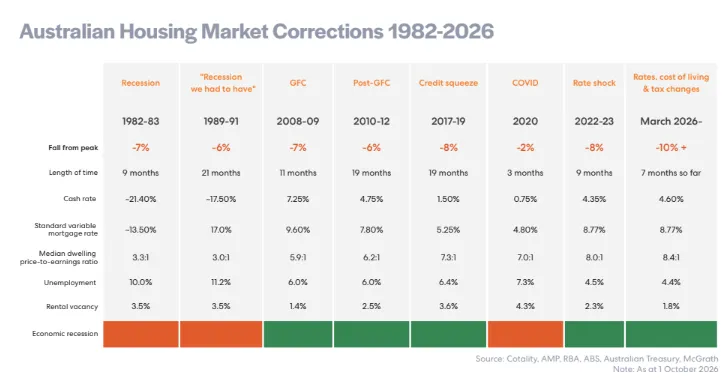
However, he argues that those figures do not fully reflect the price adjustments taking place in individual transactions, particularly in metropolitan markets where vendors are being forced to reassess their expectations.
“The data companies are reporting single-digit falls. Sydney is down 8.6% from its February peak, and 97% of capital city suburbs fell over the three months to end of September 2026. But I can assure you that on the street, most big metropolitan markets are down 10–15% in the past six months. Some are down 20%.”
He points to a recent $20.25 million mortgagee sale in Sydney’s Tamarama, which he says was 30 per cent below the property’s 2022 purchase price, as an example of the substantial adjustments occurring in some parts of the market.
While the transaction is an individual example rather than a measure of broader price movements, Mr McGrath believes the gap between published market figures and prices being negotiated on the ground is considerable.
His outlook is also more cautious for regional Australia, where he anticipates further declines even as the major cities begin approaching the end of their corrections.
“Strip out the lagging data and the sensational outliers (properties overpaid for by exuberant buyers at the peak), and the big cities are down 10–15%. The regional markets have plateaued, but they’re likely headed for a 7–10% correction over the next 12 months.”
History suggests the bottom may be approaching
Despite the scale of the downturn, Mr McGrath believes historical property cycles provide some grounds for optimism, with previous corrections generally proving shorter and less severe than many buyers and sellers anticipate during periods of uncertainty.
According to the report, Australia’s last five corrections lasted an average of 12.2 months, with an average price decline of 6 per cent. It also notes that seven previous corrections involved falls of less than 8 per cent.
He believes these historical comparisons suggest the major cities could be nearing the bottom, although he acknowledges that the timing of a recovery will depend on several economic and geopolitical factors.
“Taken at face value, the worst should be behind us. But that depends on three things: an end to interest rate rises in the near future, unemployment not blowing out and a resolution of the war in the Middle East.”
The report also highlights the opportunities that have historically emerged following housing corrections, noting that markets have gained an average of 32 per cent over the three years following comparable downturns.
While previous recoveries do not guarantee a similar result this time, Mr McGrath believes the current conditions could provide opportunities for buyers who are prepared to act while others remain cautious.
The immediate challenge is navigating a market in which sellers may be reluctant to accept lower prices while buyers continue to weigh the possibility of further falls.
McGrath warns of Bathla domino effect
Beyond the downturn in established housing, Mr McGrath raises concerns about the potential consequences of the collapse of Sydney residential developer Bathla Group, warning that the fallout could extend well beyond the projects directly affected.
Bathla entered voluntary administration in August 2026, with the report citing approximately $3.4 billion in debt and creditor claims across 219 projects, carrying a preliminary combined value of around $4.9 billion.
He believes the need to sell some of those developments in a weakening market could result in substantial discounts, placing additional pressure on developers and landowners already facing difficult conditions.
“Those projects carry a preliminary value of around $4.9 billion. But many will now need to be sold quickly, in a soft market, to developers who can take them through to completion. I believe that number may need to be discounted by 30–50%.”
The suggested discount is the estimate of a possible outcome, rather than a confirmed reduction in the value of the projects.
His concern extends to lenders, tradespeople, suppliers and purchasers, with the report highlighting the financial exposure of those involved in developments that have stalled or remain uncertain.
According to Mr McGrath, lenders have provided more than $3 billion to finance the projects, while construction has stopped on numerous sites and staff have been stood down.
He also raises concerns about buyers who paid deposits to secure properties, noting that administrators had confirmed not all purchaser deposits were held in trust.
The potential consequences for the broader development market are significant, particularly if distressed projects need to be sold at discounted prices while other developers are already struggling with construction costs, financing pressures and weaker buyer confidence.
“Each of these groups has money at serious risk. And the flow-on effect for other developers and landowners could be severe. Nobody has swept this collapse under the carpet. But I suspect the impact will be far greater, and reach far wider, than any of us have yet contemplated.”
Housing taxes and supply under scrutiny
Mr McGrath also uses the report to criticise the Federal Government’s announced changes to negative gearing and capital gains tax, arguing that the measures will do little to improve housing affordability and could discourage investment in residential property.
He contends that Australia’s housing challenges are more closely connected to the cost of delivering new homes and the difficulties developers face in bringing additional supply to market.
The report cites a 2025 Centre for International Economics study prepared for the Housing Industry Association, which estimated that approximately $380,000 of the cost of a newly built $1 million apartment in Sydney was attributable to taxes, charges and regulatory costs.
These include GST, stamp duty, developer levies, infrastructure contributions, compliance expenses and costs associated with approval delays.
He argues that reducing these costs and improving the speed of housing delivery would be more effective than increasing the tax burden on property investment.
His proposed solutions include releasing suitable land for medium-density housing, addressing rising labour and material costs, and accelerating approvals for developments that comply with planning requirements.
The criticism comes as the industry confronts a combination of falling property values, development uncertainty and continued pressure to deliver more housing.
A new property cycle before June 2027?
Despite the challenges outlined in the report, Mr McGrath remains optimistic about the longer-term direction of the Australian housing market, believing that the current correction will eventually create the conditions for another period of growth.
His outlook suggests that metropolitan markets could begin stabilising ahead of regional areas, although he acknowledges that interest rates, unemployment and developments in the Middle East could influence the timing of any recovery.
The months ahead are likely to require careful management of vendor expectations, accurate assessments of local market conditions and an ability to help buyers recognise opportunities without assuming that every market has reached its lowest point.
His final assessment is that while the industry may still have difficult conditions to navigate, the current downturn will ultimately give way to another property cycle.
“So in summary, it’s been a turbulent period with some more headwinds to come but having been through a number of corrections I’ve learnt one thing … property and economic cycles are guaranteed to come and equally guaranteed to go. We will be into the new cycle before the end of this financial year.”
With buyers gaining negotiating power and sellers adjusting to lower prices, Mr McGrath’s forecast offers a cautiously optimistic outlook for the industry, even as the timing and strength of the next recovery remain uncertain.
Where John McGrath sees opportunities in 2027
| Market | Five locations |
|---|---|
| Sydney | Campsie, Sandringham, Glebe, Roseville Chase, Wamberal |
| Regional NSW | Narooma, Coffs Harbour, Caerleon, Estella, Inverell |
| Melbourne | Sunshine, Boronia, Highett, Reservoir, Werribee |
| Regional Victoria | Mildura, Kyneton, Bendigo, Jan Juc, North Shore (Geelong) |
| Brisbane & Gold Coast | Beenleigh, Caboolture, Jindalee, Sandgate, Palm Beach |
| Regional Queensland | Toowoomba, Maryborough, Nambour, Charters Towers, Cairns North |
| Hobart | Chigwell, Rokeby, Taroona, New Norfolk, Gagebrook |
| Regional Tasmania | Mayfield, Waverley, East Devonport, Spreyton, Park Grove |