
“Play the long game.”
I’ve heard this phrase in real estate for years. Don’t chase the quick fix. Do the right thing for the long term – if you want career longevity, that is.
But when it comes to lead generation, playing the long game means patience. And patience is a hard sell when you’ve got a target to meet this month.
So let’s talk about the three ways agents get leads, because two of them keep you running and one of them actually builds something.
Outbound – cold calling, purchased lists, door knocking – has been the default for decades. It works, but it runs on your energy. Every day. The moment you stop, the leads stop too.
Bought leads – paying for a name and a phone number – solve an immediate problem but create a dependency. You’re buying a fish. You eat it today. Tomorrow you need another one.
Inbound – content, SEO, email nurture – is where I see the real opportunity. Not because it’s easy, but because it compounds. It’s like building a boat and learning to fish for yourself. More work up front, but you can eat for a lifetime. A piece of valuable content attracts leads this week, next month, and next year. The work is front-loaded. The flow becomes stable.
But not all content is created equal.
Now – I imagine if I’d called this article “How to Improve Your SEO,” you might have switched off before this point. But seeing as you’re still here, you need to know: not all articles are created equal either.
This is the first in a series where I’m opening up the thinking behind how we built Ailsa – our AI journalist at Elite Agent.

Yes, I’m going to talk about our product. But I’m also going to give you the whole playbook, so if you want to do it yourself, go for it.
It starts with the URL
Here’s the first thing most people miss entirely.
Look at some recent just-sold article URLs on Elite Agent:
- https://eliteagent.com/sam-radal-real-estate-quakers-hill-dkwmq/
- https://eliteagent.com/matilda-downard-real-estate-australind-xw14m/
- https://eliteagent.com/john-castrisos-real-estate-north-bondi-ytx86/
See it? Agent name. The words “real estate.” The suburb.
That URL contains your name, your industry, and your location – which means it has a chance of showing up whether someone searches for you by name, searches for agents in your area, or some combination of both.
This isn’t an accident. We designed it this way because URL structure is one of the most underrated signals in SEO. It’s the first thing Google reads, and it’s permanent.
If you’re doing this yourself: Make sure your URL slug is clean, descriptive, and includes your suburb. Don’t let WordPress auto-generate a slug full of stop words. Something like four-offers-broadbeach-waters-duplex is better than my-latest-sale-number-47.
The three-layer title trick
Here’s something you can’t see from the front page of an article, but Google and social media can.
A well-optimised article has three different titles, each doing a different job.
The headline is what you see on the site. It tells the story:
“Four offers in four days: How Sam Radal’s sensory marketing created competition in Quakers Hill”
The search title is what shows up in Google results. It gets the click:
“Four offers in four days: Sam Radal’s Quakers Hill sale | Elite Agent”
The meta description is the snippet underneath. It pre-sells the article with facts:
“Sam Radal secured $1,150,000 for a three-bedroom duplex at 6 Olive Lee Street, Quakers Hill, after a presentation-focused campaign generated 29 buyers and four offers in a single opening weekend.”
Three titles. Three jobs. The headline draws you in, the search title earns the click, and the meta description packs in the specifics – agent name, price, address, suburb, and the hook.
We built Ailsa to generate all three automatically because getting them right consistently is tedious work.
Title length under 60 characters? Green. Meta description with specifics? Green. Focus keyword? Green. Readability? Green. Every article, every time.
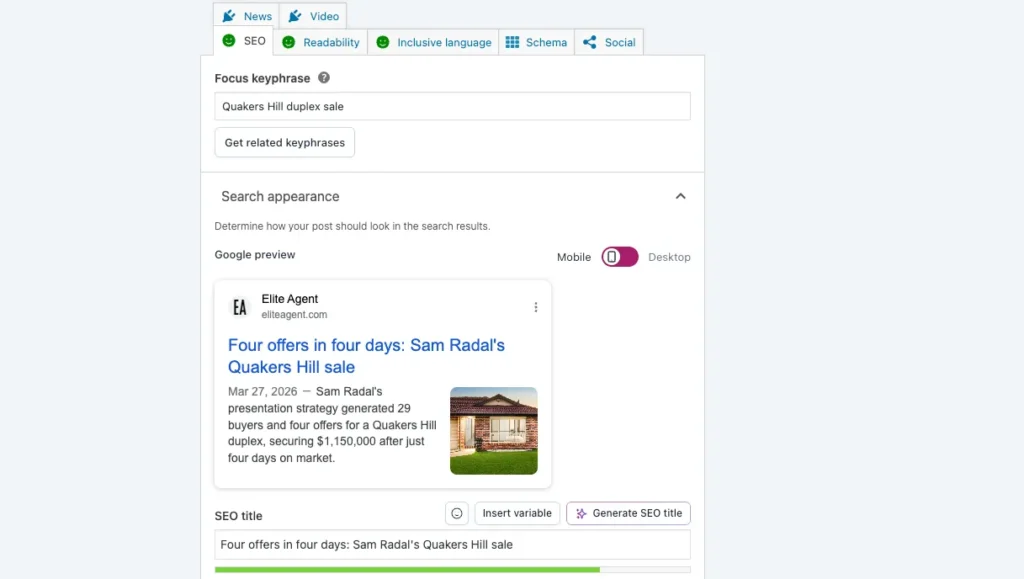
If you’re doing this yourself: Your headline can be as creative as you like, but your SEO title (the one in Yoast or RankMath) should be under 60 characters and include your name and suburb. Your meta description should include the price, the address, and one compelling fact. Yes, this is fiddly. Yes, it matters. Yes, you can prompt AI for all of it. If you like typing and clicking buttons.
The standfirst: one paragraph doing six jobs
Every article on Elite Agent opens with a single bolded paragraph right under the hero image.
Think of it as the TL;DR. It tells you who sold what, where, for how much, how fast, and why it’s interesting. All in one sentence.
It’s the paragraph Google is most likely to pull as a featured snippet, and it’s the first thing a vendor sees when they find you in search. So it needs to work on its own.
Here’s a real one from Matilda Downard’s article:
“Matilda Downard has sold a four-bedroom family home at 10 Wickham Way in Australind for $750,000 after 23 days on market, helping vendors who had lived there for 35 years secure their retirement property.”
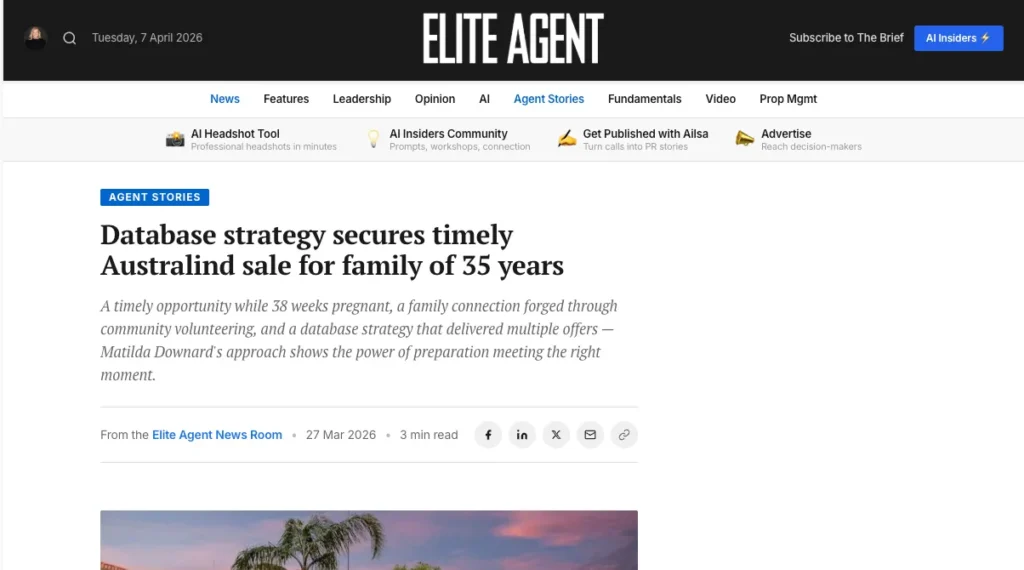
In one sentence: agent name, property type, full street address, suburb, price, timeframe, and a human hook.
Here’s Jake Gardam’s:
“Jake Gardam sold a three-bedroom house at 2/34 Crosss Road in Traralgon, Victoria for $650,000 after just five days on market, using a strategic social media preview to test buyer appetite before official launch.”
Same formula. Different story. Every time.
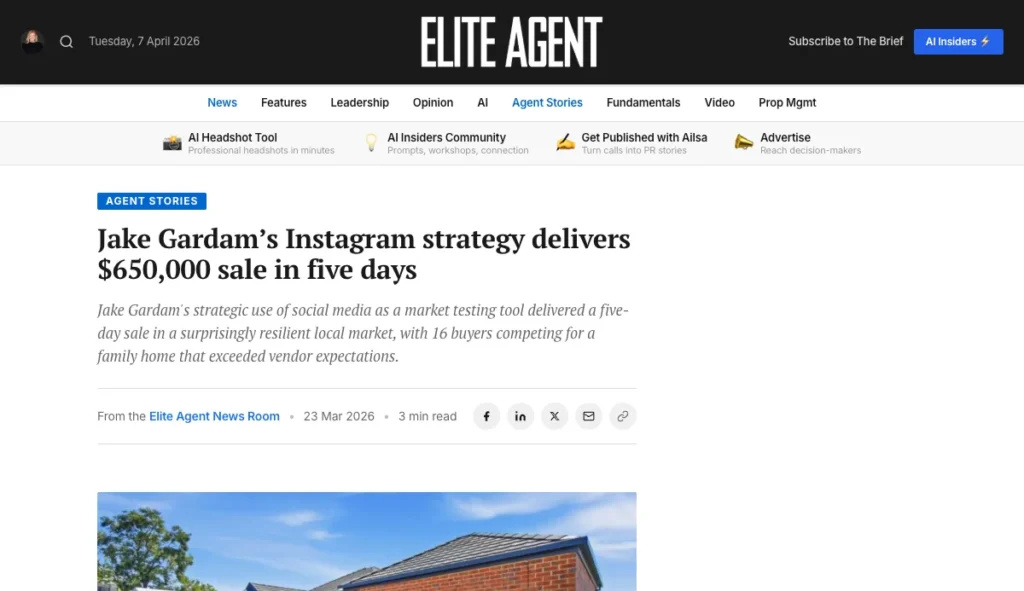
This is what Google pulls as the featured snippet. It’s what someone sees when they search your name. And it’s packed with exactly the kind of specifics that make you look like the expert you are.
If you’re doing this yourself: Write your standfirst first. Use this formula: [Your name] has sold [property type] at [full address] in [suburb] for [price] after [timeframe], [human hook]. If every article you write starts with this one sentence, you’re building an SEO machine without realising it.
The Portal Test
This is the holy grail – if you like – that separates a real case study from every other “just-sold” post on the internet.
Take your article and strip out every piece of information already available on the portals or CoreLogic – the address, the price, the bedrooms, the days on market.
Is there still a story?
If the answer is no, you need to find one.
Matilda Downard was 38 weeks pregnant when she listed the property. John Castrisos walked into a house so full of accumulated belongings it was unlivable – and still got it $500,000 over reserve at auction. Sam Radal spent the morning of the open steaming the carpet, placing fresh flowers, and brewing coffee so buyers walked into an experience, not just a house.
None of that is on the portals. It came from the agent’s own story. It’s what Google calls the “E” in E-E-A-T – Experience. The thing only you know because you were there.
We called it the Portal Test and built it directly into Ailsa’s editorial process. The interview with Ailsa is specifically instructed to prioritise what the usual “results” don’t show – buyer profiles, competition stories, your micro-market read, what buyers noticed at inspections, and what surprised you about the campaign.
If you’re doing this yourself: After you write your article, cover the address, price, and bed count with your hand. Is there still a story? If not, go back and add what only you know. The buyer who drove three hours to get to the open. The vendor who nearly didn’t list. The neighbour who missed out and is still looking. That’s the content Google can’t find anywhere else.
Subheadings that tell a story, not label a section
The body of a good article should unfold through four to six sections with descriptive subheadings. Not generic ones – narrative ones.
Compare these:
“The Strategy” → tells you nothing.
“The preparation sprint” – when the agent had 10 days to get a hoarder’s house presentable – tells you everything. You can scan the subheadings alone and get the shape of the whole campaign.
Other examples from real articles: “Creating the sensory experience.” “The buyer who wouldn’t be ignored.” “The Australind market read.”
Each one hints at a story. But they are a scannable story in their own right.
If you’re doing this yourself: Write your subheadings after you’ve written the body. Look at each section and ask: what’s the one interesting thing here? That’s your subheading. Or ask an AI: “Read each section and suggest a subheading that hints at the story, not just the topic. ‘The preparation strategy’ is boring. ‘The preparation sprint’ is interesting. Give me options.”
The bio: your permanent business card
Every article should close with an author bio. This is the bit that does quiet, persistent work.
A bio on your own site is expected – of course it’s there. A bio at the bottom of a published editorial piece on a shared industry platform is a business card in context.
Keep it to 50 – 75 words, third person, with your website link and phone number. Use the same one on every article and update it quarterly.
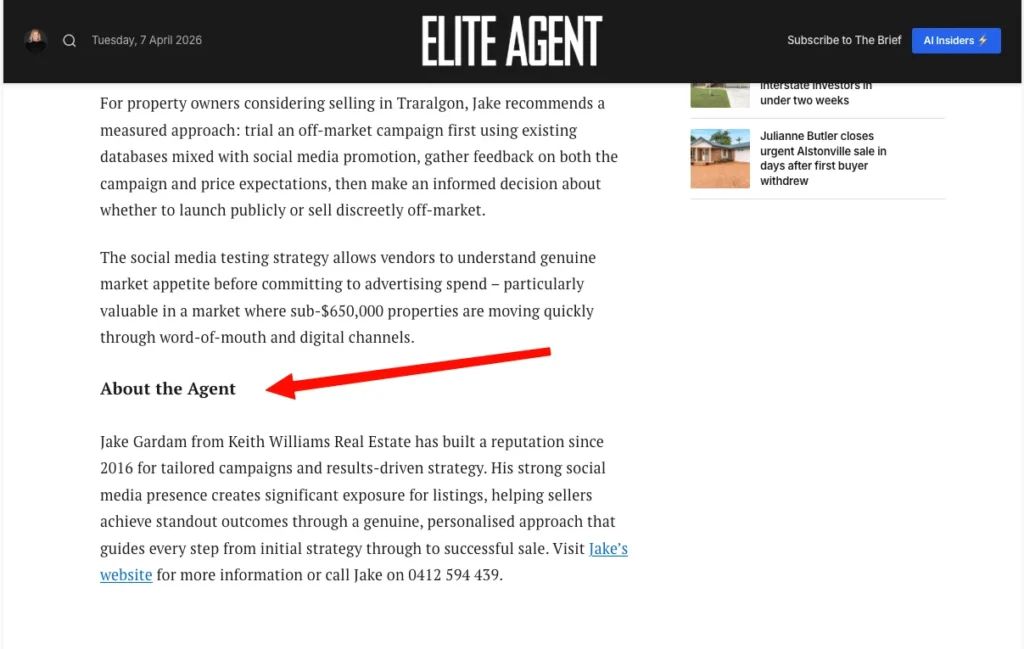
The reason this matters: when a vendor Googles you at 11 pm, and maybe lands on this article it’s an easy way to contact you, rather than being an easter egg hunt.
The compound effect
One article is a nice thing to have. Twenty articles starts to look like a moat.
Think about what happens when a vendor searches your name six months from now. Instead of finding the odd social post, they find a string of well-written editorial articles – each telling the story of a real sale, with your strategy, your market read, your quotes, your name in the URL.
Each article builds on the last. Each one is another page ranking data point. Another proof point. Another reason a vendor you’ve never met thinks: ‘This agent looks as though they know what they’re doing.
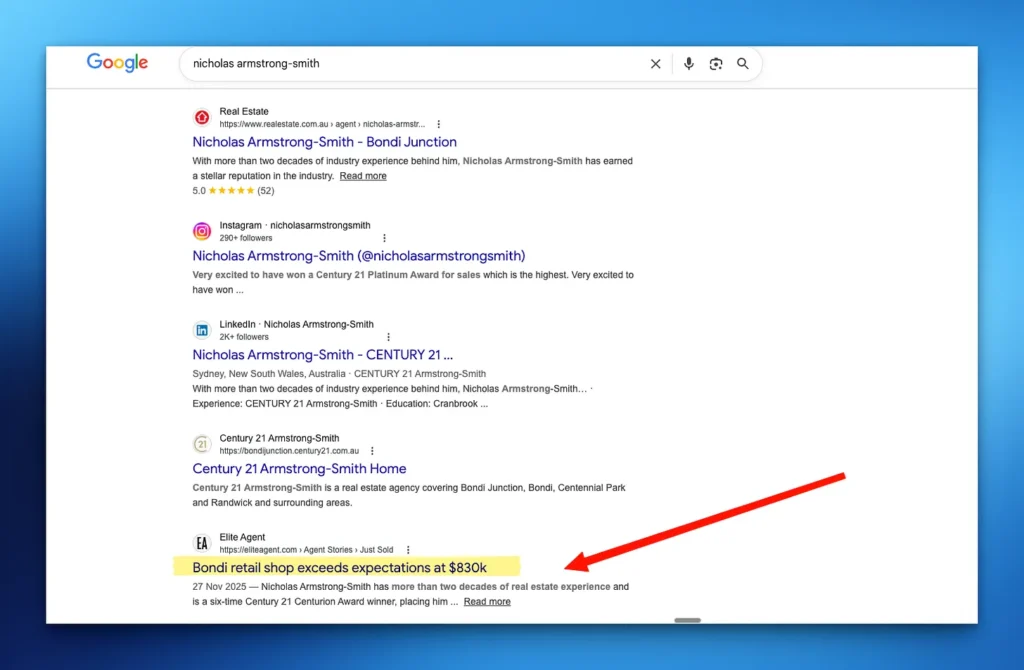
Your letterbox drop may do that if someone reads it. But six months down the track, it will be long forgotten. But this story and the link live on.
The honest bit
Can you build all of this yourself? Yes. Everything I’ve described – the URL structure, the three-layer titles, the standfirst formula, the Portal Test, the narrative subheadings – you can apply all of it to your own content that you are creating.
Ideally, you’d be publishing on your own website too.
Your site is where your Experience and Expertise live – two of the four pillars in Google’s E-E-A-T framework.
A well-built agent website with strong local content absolutely earns its place in search results, and if you’re doing that already, keep going.
But many agents aren’t.
And that’s where Ailsa comes in – not as a replacement for your own content strategy, but as a starting point.
If you’re not publishing anything right now, a 10-minute phone call that produces an editorial article on an established industry domain is a much better first step than a blank WordPress page you’ll never get around to filling.
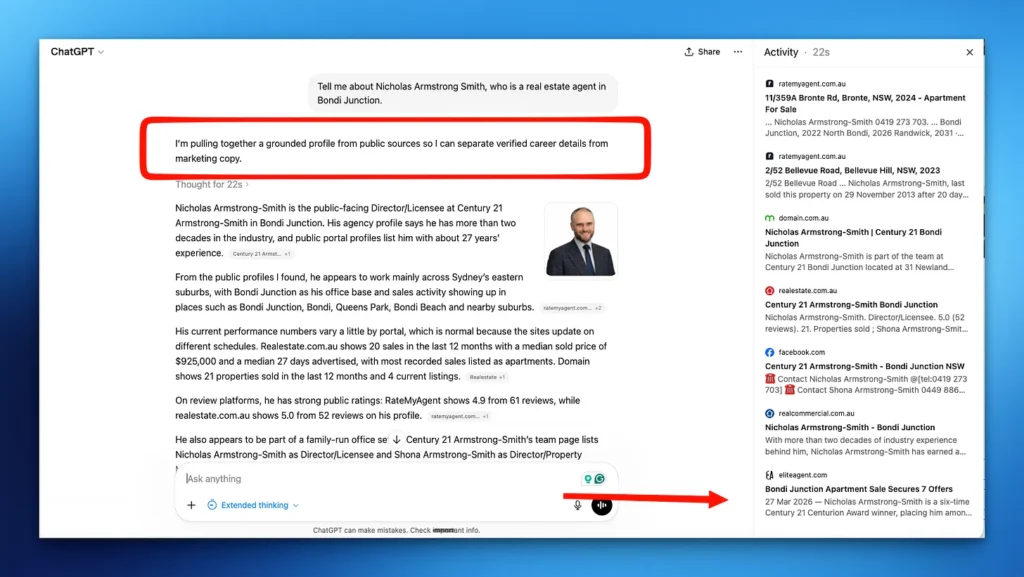
…And… you can see below ChatGPT is saying, “I’m pulling together a grounded profile from public sources so I can separate verified career details from marketing copy.”
The other thing that’s hard to replicate is consistency. Most agents write one article, maybe two. They get busy and stop.
We designed Ailsa as a 10-minute phone call after each sale, specifically because friction is the enemy of compounding.
You can keep buying fish. Nothing wrong with fish.
But if there is not enough of you online right now – the kind of SEO presence that works 24/7, compounds over time, and has your name on it, Ailsa is likely the easiest place to start.
This is the first in a series where I crack open how I built Ailsa – our AI journalist at Elite Agent. Think of it as showing you inside my brain a little; (be brave, it’s not for the faint-hearted… !)
Next up: How to repurpose one article into several social posts (of course, using AI!)
Want to see what Ailsa can do for your next sale? Get started at getailsa.com.