

First home buyers are gaining ground in Australia’s housing market as investor activity declines, but rising interest rates are threatening to undermine the benefits of falling property prices and reduced competition.
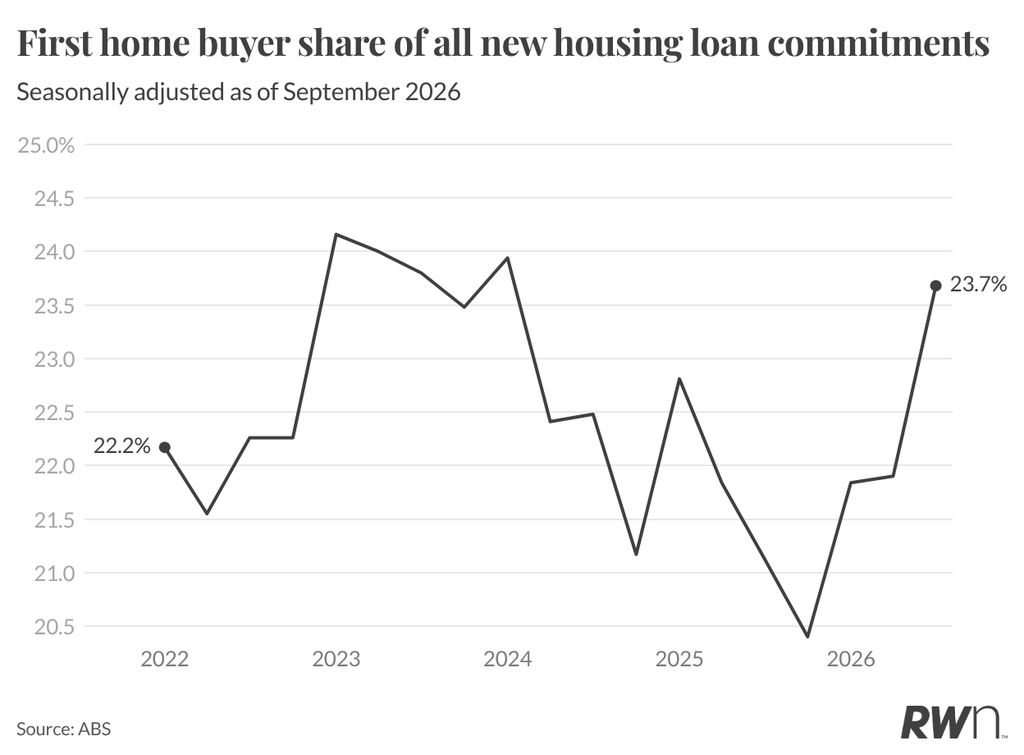
New analysis from Ray White Group Economist Atom Go Tian shows first home buyers accounted for 23.7 per cent of all new housing loans in the September quarter of 2026, up from 20.4 per cent in the December quarter of 2025, when their share reached its lowest level since records began in 2002.
The turnaround followed the expansion of the Federal Government’s five per cent deposit scheme in October 2025, although the improvement masks a broader contraction in housing lending.
Since the scheme was expanded, the number of new housing loans written each quarter has fallen by about 30,500, with investors accounting for the overwhelming majority of the decline.
First home buyer loans fell by about 3,600, compared with 4,800 fewer loans to existing owner-occupiers and 22,100 fewer loans to investors.
For every first home buyer loan lost, 6.2 investor loans were lost.
Less competition but fewer buyers
The September quarter was the first full quarter following the 12 May Federal Budget, which restricted negative gearing on established homes purchased after Budget night.
While the Government has positioned the changes as a way to level the playing field for first home buyers, Mr Go Tian said the figures tell a more complicated story.
“The Government says the change is meant to level the playing field for first home buyers, but at the moment, the share is rising because investors are falling faster, rather than because first home buyers are entering,” he said.
Historically, first home buyers have accounted for a considerably larger proportion of housing lending, representing about 28 per cent of new loans in 2002 before reaching almost 48 per cent in 2009, when the government doubled the First Home Owners Grant during the global financial crisis.
Their share remained above 25 per cent for most of the following decade before settling in the low 20s from 2022.
According to Mr Go Tian’s modelling, first home buyers could again account for one in four new housing loans if investor lending fell a further 17 per cent to about 29,400 loans a quarter, or if first home buyer lending increased by seven per cent to about 28,500 loans.
A combination of a 10 per cent decline in investor lending and a five per cent increase in first home buyer loans would also push their share above 25 per cent.
All three scenarios assume existing owner-occupier lending remains steady.
Interest rates remain the final hurdle
While falling property prices and reduced investor competition are creating opportunities for prospective first home buyers, the rising cost of borrowing remains a significant obstacle.
According to Mr Go Tian, house prices have fallen between three and 10 per cent since April, bringing more properties within the price caps of the expanded five per cent deposit scheme.
However, the cash rate has increased by 1.25 percentage points to 4.85 per cent, its highest level since 2008, largely offsetting the benefit of falling property prices on monthly mortgage repayments in most capital cities.
“Yes, the Budget has proven effective in bringing down house prices and reducing competition in the market, but interest rates are proving the final hurdle in enabling first home buyers,” Mr Go Tian said.
“Lower prices and smaller deposits do little when lending is this expensive.”
For real estate agents, the figures highlight an important distinction between improving purchase opportunities and buyers having the financial capacity to act on them.
While reduced investor competition may give first home buyers more room to negotiate, the direction of interest rates will be critical in determining whether more of them can successfully enter the market.
“A pause or a cut would let lower prices and smaller deposits count,” Mr Go Tian said.
“More rises would keep first home buyer loans falling. The share could still reach one in four, but only because investors fall further.”