

Australia’s housing downturn may be reducing the cost of purchasing a home, but new research shows buyers are receiving little relief when it comes to servicing a mortgage.
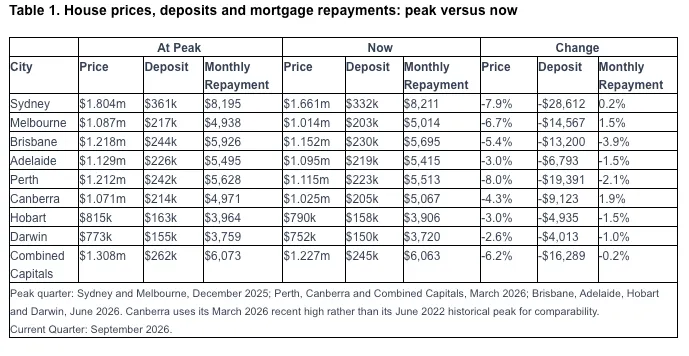
New analysis from Domain reveals house prices across the combined capitals have fallen approximately $81,000 from their peak, reducing the deposit required by $16,289.
However, estimated monthly mortgage repayments have dropped by just 0.2 per cent, from $6,073 to $6,063, as higher borrowing costs offset much of the benefit of falling property values.
The findings highlight a challenge for the real estate industry, with agents navigating a market where lower property prices do not necessarily translate into improved mortgage affordability for prospective buyers.
The analysis follows a September quarter in which house prices fell across every capital city for the first time in 15 years, and only the second time on record.
Domain Chief Residential Economist Dr Nicola Powell said the figures exposed the disconnect between property prices and the cost of financing a purchase.
“Comparing the monthly repayments required at each city’s price peak with those required today shows just how much borrowing costs have offset falling prices. In some cities, buyers are actually paying more each month to service a mortgage on a cheaper home.”
Sydney buyers paying more despite falling prices
Sydney provides one of the clearest examples of how higher interest rates have changed the affordability equation.
House prices have fallen 7.9 per cent from their December 2025 peak, bringing the median down from approximately $1.804 million to $1.661 million.
That has reduced the deposit required by $28,612, yet estimated monthly mortgage repayments have increased from $8,195 to $8,211.
Melbourne buyers face a similar situation, with house prices down 6.7 per cent from their peak but monthly repayments up 1.5 per cent to $5,014.
In Canberra, prices have declined 4.3 per cent from their recent high, while estimated repayments have risen 1.9 per cent to $5,067.
Dr Powell said falling property values were not necessarily translating into meaningful financial relief.
“Sydney is a clear example. House prices are 7.9% below their December 2025 peak, cutting the deposit required by $28,612. Yet estimated monthly repayments are now 0.2% higher, at $8,211 compared with $8,195. Melbourne and Canberra show a similar pattern, with repayments up 1.5% and 1.9% respectively, despite prices falling.
“Falling house prices are making it cheaper to buy, but not necessarily more affordable to borrow. Buyers need a smaller deposit, but higher interest rates mean the cost of servicing the mortgage has barely changed.”
Other capitals have experienced some improvement, although the benefits remain relatively modest.
Perth has recorded the largest house price decline among the capitals, falling 8 per cent from its peak, but estimated monthly repayments have decreased by just 2.1 per cent.
Brisbane has delivered the greatest repayment relief, with house prices down 5.4 per cent and monthly repayments falling 3.9 per cent, or $231 a month.
This partly reflects the timing of Brisbane’s price peak in June 2026, with only one interest rate increase occurring between that quarter and September.
Adelaide, Hobart and Darwin have recorded repayment reductions of between 1 per cent and 1.5 per cent.
How much further would prices need to fall?
Domain’s modelling suggests a substantially larger adjustment in property prices would be required to deliver meaningful mortgage affordability improvements if borrowing costs remain at their assumed September-quarter levels.
Across the combined capitals, house prices would need to fall a further 9.8 per cent for estimated monthly repayments to be 10 per cent below their peak-quarter levels.
In Sydney, that would require another 10.2 per cent decline, taking the median house price from approximately $1.66 million to $1.49 million.
Melbourne would need a further 11.4 per cent fall, bringing its median to approximately $899,000, while Canberra would require the largest additional adjustment at 11.7 per cent.
Brisbane is closest to achieving the modelled improvement, requiring a further 6.3 per cent decline.
Importantly, Domain stressed these figures are not forecasts of future property prices, but calculations illustrating the scale of the adjustment required to offset higher borrowing costs.
Dr Powell said the limited improvement in repayments also meant some buyers who were previously unable to secure finance could still face the same barriers.
“With estimated repayments close to, or above, their peak-quarter levels in most capitals, a household unable to meet a lender’s serviceability requirements at the peak may be little better placed today, all else being equal.”
What it means for agents and buyers
The findings underline an important distinction for agents working with buyers in a declining market: a lower purchase price does not automatically mean a property has become more affordable to finance.
While falling prices have reduced the upfront deposit hurdle, buyers’ ability to service a mortgage remains heavily influenced by interest rates.
With estimated repayments remaining close to, or above, their peak-quarter levels in most capitals, lower property prices may offer limited relief to buyers whose ability to secure finance is constrained by servicing costs.
The Reserve Bank has raised the cash rate five times in 2026, taking it to 4.85 per cent, with Domain warning that further increases could place additional pressure on mortgage affordability.
The analysis uses a 20 per cent deposit and a 30-year principal-and-interest mortgage, based on average new owner-occupier lending rates for the relevant quarters.
The September-quarter mortgage rate is provisional, using the August rate plus 0.25 percentage points to reflect the 30 September cash rate increase.
Each capital is compared with its own recent price peak, with Canberra’s March 2026 high used instead of its historical June 2022 peak to provide a more comparable interest-rate setting.
Additional purchasing costs, including stamp duty and conveyancing fees, are excluded.