

Victoria’s land market is set for a major recovery in 2026, while South East Queensland and Adelaide continue to outperform.
According to the latest Quarterly Market Insights (QMI) from Oliver Hume Property Group, the December 2025 QMI analysed thousands of land sales across Melbourne, SEQ, and Adelaide, revealing strong market signals heading into the new year.
Victoria: recovery on the horizon
By the end of 2025, Victoria’s 12-month sales volumes had jumped by around 40% to over 9,000, with median land prices up 4%. Oliver Hume expects Melbourne’s market to continue its recovery in 2026, supported by improvements in the established market.
Oliver Hume CEO Julian Coppini said underlying demand remains resilient despite higher interest rates and supply constraints.
“Australians have an insatiable appetite for home ownership and that aspiration has not changed, regardless of the rate cycle or the headlines of the day. People still want a place to call their own. They still want the security, lifestyle and long-term wealth creation that comes with owning a home. That underlying demand has proven remarkably resilient,” she said.
“Even with the recent rate increase, enquiry levels in many markets have remained steady with exceptionally strong demand in Queensland and South Australia.”
The Victorian land market has faced challenges after the lowest sales volumes in 15 years during 2023 and 2024, with many established homes selling at discounts to new builds.
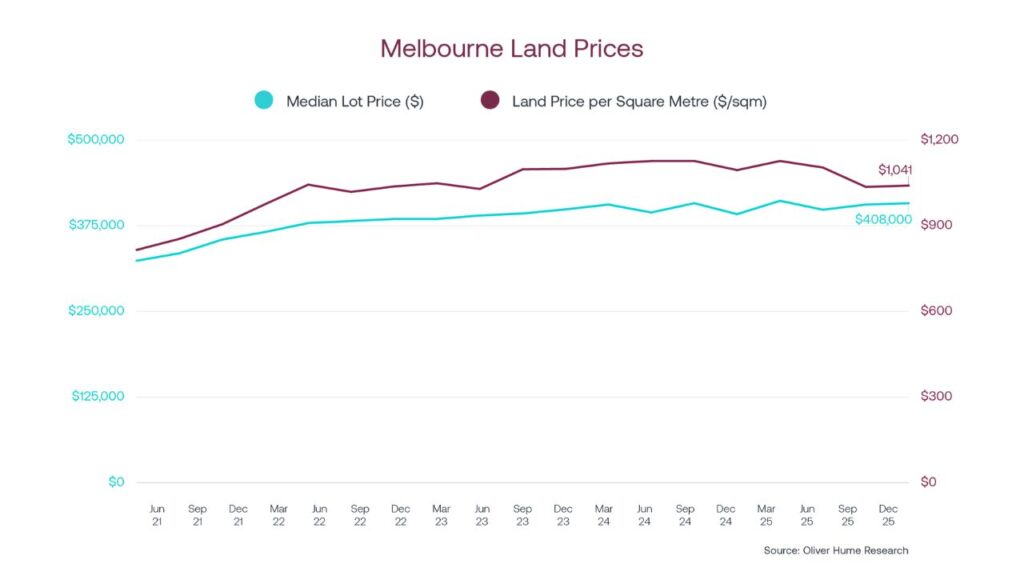
Ms Coppini said this has temporarily suppressed activity.
“It is not because Victorians no longer want to build, it is because the established market has not provided the price growth necessary to make new construction stack up. The market will not remain out of balance forever.
“There will come a point where the discount in Victoria becomes too compelling to ignore. Investors and owner occupiers alike will recognise the relative value on offer. When that shift in sentiment happens, and the established market begins to show sustained price growth, the land market will respond quickly.”
Oliver Hume Chief Economist Matt Bell added that years of underselling compared to population growth means there was elevated pent-up demand that will need new housing.
“First home buyer incentives are strong and credit remains readily available. Households are spending again and the unemployment rate is low.”
South East Queensland: high prices, strong demand
SEQ land sales in the December 2025 quarter fell back to December 2024 and March 2025 levels, below the long-term average. But Mr Bell said strong price growth confirms a highly undersupplied market:
“One key difference to the Melbourne market is the performance of the local established housing market. Annual price growth ended the year at just under 15%, keeping new house and land competitive, even as affordability became even more stretched across both markets.
“The changing rate outlook has had less of an impact in this heavily undersupplied market. Prices rose another 3.1% to add to the 10% in the September quarter, leaving prices 27.5% higher than 12 months ago, outpacing a hot established market.”
Oliver Hume expects that if developers can produce more stock, 2026 sales will rise toward long-term averages, with price growth easing closer to established market levels of 10–15%.
Adelaide: limited supply drives growth
Adelaide’s market also remains constrained by limited supply, driving strong price growth. The median lot price rose 6% in the December quarter to $371,000, maintaining annual growth at 27%. Price per square metre rose 6.8% for the quarter and 41% for the year, while median lot sizes fell 10% to 378sqm.
“Like South East Queensland, the outlook for sales for 2026 depends highly on the ability of developers to bring new product to market,” Mr Bell said.
“The price growth the market is seeing proves the demand is there, and once supply starts flowing, we expect the sales to follow.”
Despite the spike, Adelaide land prices remain lower than Melbourne and SEQ, though in $/sqm terms they sit only 15% behind Melbourne.

