

Australians are increasingly embracing “rightsizing” – moving from traditional family homes into luxury apartments – and the impact on the prestige apartment market is clear.
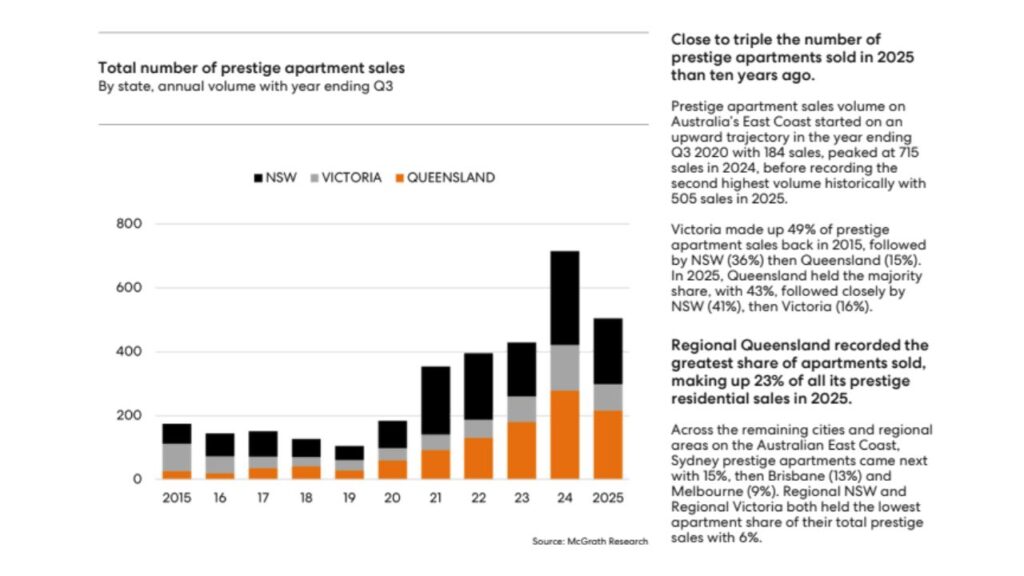
McGrath Research data reveals that the number of prestige apartments sold in 2025 has trebled over the past 10 years, signaling a sustained shift in buyer preferences.
“Prestige apartments have been the strongest market segment in the last few years as high-net-worth individuals choose luxury, security and lifestyle in apartments over houses,” McGrath CEO John McGrath said.
“Demand has increased dramatically as luxury apartments have gone to a whole new level in design, finishes and amenities.”
Queensland has led the upswing, accounting for 43 per cent of East Coast prestige apartment sales in 2025, followed closely by NSW at 41 per cent and Victoria at 16 per cent.
Within Queensland, regional areas recorded the largest share of high-end apartment sales, making up 23 per cent of all prestige residential sales.
“Southeast Queensland has become the favoured location for many looking for luxury apartment living as pristine beaches and rivers become perfect backdrops for beautiful buildings,” Mr McGrath added.
“The strongest demand has been for prime locations with easy access to major cities as most buyers in these apartments are still living very active and vibrant lives.”
Price growth has mirrored the demand. Over the past five years, new prestige apartments have outperformed established units, rising +88 per cent on the Gold Coast, +60 per cent in Brisbane, +34 per cent in Sydney, and +32 per cent in Melbourne.
Analysts point to several factors driving this growth: larger floor plans, best-in-class amenities, superior materials, and a historically low supply of new luxury apartments for Australia’s growing wealthy population.
Developers are responding with larger, more sophisticated apartments according to Michelle Ciesielski, McGrath’s National Head of Research.
“After identifying the emerging rightsizing trend in Australia back in 2020, there has been more than double the delivery of apartments with three or more bedrooms, and the average apartment built was one-third larger.”
Looking ahead, Ms Ciesielski forecasts that by 2028, 40 per cent of apartments in prime regions of Melbourne and Brisbane will feature more than three bedrooms, with 34 per cent on the Gold Coast and 31 per cent in Sydney.
Average sizes for three-bedroom prestige apartments are expected to start from 160 sqm in Melbourne, 166 sqm in Sydney, 172 sqm in Brisbane, and 190 sqm on the Gold Coast.
Multiple car spaces are becoming a priority for buyers seeking convenience, lifestyle vehicles, and space for collectables.
Sydney commands a 62 per cent price premium for three-bedroom apartments with more than four car spaces compared to just one; Brisbane 47 per cent, Gold Coast 46 per cent, and Melbourne 41 per cent.
Over the past five years, Brisbane had the greatest number of sales with more than four car spaces.
Amenities are also central to the new luxury apartment market. More than two-thirds of buildings across Sydney, Melbourne, and Brisbane CBDs now feature a pool and gym.
“Many rightsizers are seasoned global travellers, shaping their expectations for amenities in their new home based on luxury hotel experiences. Australia has a long way to go and developers must get this balance right given the more competitive marketplace,” said Ms Ciesielski.
Despite strong demand, the cost of delivering premium apartments remains high.
Rising material prices and a shortage of skilled labour, particularly for specialist trades, have driven up development costs.
“High-net-worth demand for luxury downsizing remains strong, although purchase price and ongoing costs will always be a decisive factor when giving up the space of a family home,” she said.
“Our study found that prestige apartments generally incur lower upkeep costs compared to similar quality standalone houses, when sinking funds are appropriately managed.”