
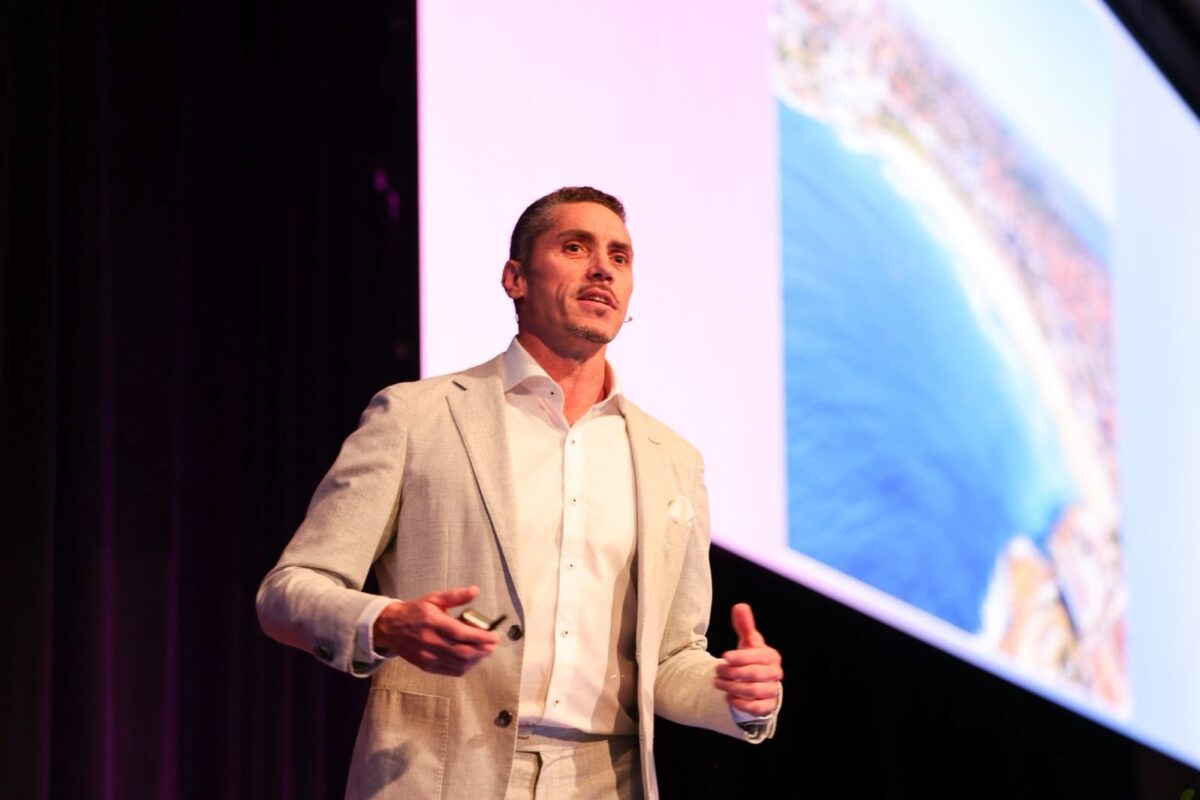
When a setback arrives, Quinn Darragh returns to three questions: what do I still have, what can I change, and what can I start with?
The Bondi lifeguard and former NSW Ambulance paramedic shared his “resilience loop” at PM/ONE 2026, drawing on experiences that had repeatedly forced him to rebuild.
For property managers and leaders, his message was to take stock, find something within their control and choose a small next step.
Three questions to move forward
Quinn described the first part of the loop as gratitude: noticing what remains available when circumstances change.
He recalled recovering from major surgery and holding his newborn son, a moment that helped him turn his attention towards his family and the things he still had.
“I started to look at what I had, not what I didn’t,” he said.
Optimism came next. For Quinn, that meant directing attention towards his sphere of influence, while recognising there were circumstances he could not change.
The third element was focus: setting small goals that gave him somewhere to begin.
He described rebuilding his swimming fitness after a liver transplant, progressing from two pool laps to 500 metres, then gradually increasing what he could manage.
Those incremental goals eventually led to an attempt to swim continuously at Bondi for 24 hours.
A setback is part of the story
Quinn told delegates he was pulled from the water after 12 hours and 40 minutes. He had fallen short of his time target, but completed 64 laps, breaking the beach’s continuous swimming lap record.
His point was about how to interpret that result. Disappointment could become a verdict on his ability, or information to take into another attempt.
“Just speak to yourself like you’re speaking to your best friend,” he said.
He encouraged delegates to ask whether a setback was permanent or temporary, whether it affected everything or just one thing, and whether there was something they could change.
For leaders, Quinn also drew a distinction between having difficulty imposed on someone and giving them some authority over how they tackle it. That sense of ownership, he said, could change their approach to a difficult task.
His final invitation was simple: contact someone whose support had made a lasting difference and tell them why.
Quinn had recently texted someone who gave him an early career opportunity. The response, and the conversations that followed, revealed how much the message mattered to its recipient.
“Gratitude, it changes what you see, and optimism changes what you do,” he said.
Actionable
- Name what you still have when a setback arrives.
- Choose one small step within your sphere of influence.
- Give team members some authority over difficult tasks.
- Speak to yourself as you would a close friend.
- Thank someone whose support made a lasting difference.