
Australia’s housing market may be cooling on the surface, but the fundamentals driving affordability are moving in the wrong direction.
That’s the assessment from Ray White Group chief economist Nerida Conisbee, who says slowing monthly price growth masks a deepening structural problem: the rising cost of building new homes.
“What we are seeing is not an easing of the housing shortage, but a shift in how it is playing out,” Ms Conisbee said.
While Sydney prices are now declining and buyer activity has softened, Ms Conisbee points to construction costs as the core issue.
Labour shortages and supply chain disruptions pushed building costs sharply higher through 2022 and 2023. That growth moderated briefly but never returned to normal levels.
Now, a second wave of pressure is emerging.
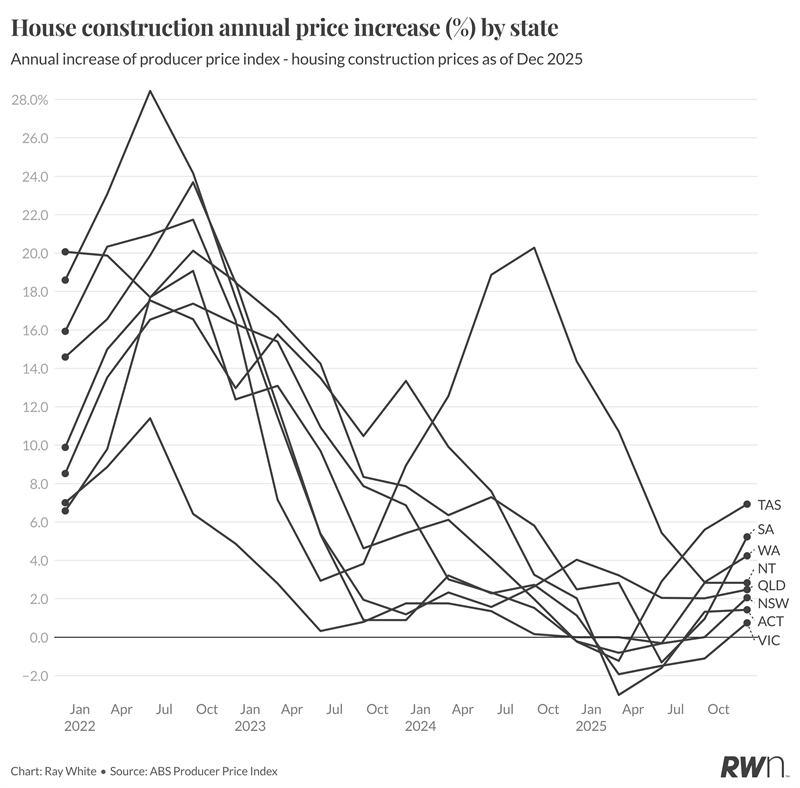
Conflict in the Middle East is contributing to higher fuel costs and renewed shipping disruptions, which Ms Conisbee expects will flow through to increased material and construction costs in the months ahead.
“Labour shortages have not been resolved, and now supply chain disruptions are adding a second layer of cost pressure to the construction sector,” she said.
The impact on housing supply is significant. Higher and more volatile construction costs reduce the feasibility of new developments.
Projects are delayed, scaled back or abandoned, while builders remain cautious amid cost uncertainty and tighter financial conditions.
Meanwhile, demand continues to grow, supported by strong population growth and limited existing stock.
The latest price data reflects this imbalance.
Despite softer monthly growth, annual increases remain strong across most of the country.
Perth and Darwin continue to lead, while Brisbane, Adelaide and many regional areas remain in double-digit territory.
Even where prices are falling, declines have been modest and concentrated in interest rate-sensitive markets.
The unit market tells a similar story.
Apartment prices have proven more resilient than houses, supported by affordability pressures and first home buyer incentives.
But new apartment supply remains limited, reducing the ability of this segment to provide relief.
Ms Conisbee said the cyclical slowdown driven by higher interest rates is occurring against a structural housing shortage now being reinforced by rising construction costs.
“Affordability is not improving. It is likely to worsen,” she said.
“Slower price growth does little to offset the fact that new housing is becoming more expensive to deliver, limiting supply and placing upward pressure on prices over time.”