
Sydney’s housing market has reversed its typical pattern, with the city’s most affordable homes now outpacing premium properties in price growth – a shift Ray White chief economist Nerida Conisbee describes as a “K-turn” (otherwise known as a three-point turn).
Since late 2023, house prices at the 25th percentile of the Sydney market have risen around twice as fast as those at the 75th percentile, according to Ray White analysis.
The gap between lower and upper-end price growth is now the largest among Australia’s capital cities.
“Instead of premium properties leading the market, price growth is increasingly concentrated in the cheapest homes,” Ms Conisbee said.
The pattern marks a notable departure from the past two decades, when Sydney’s housing booms were typically led by expensive properties.
During the mid-2010s surge and the pandemic years, premium suburbs consistently outperformed the rest of the market.
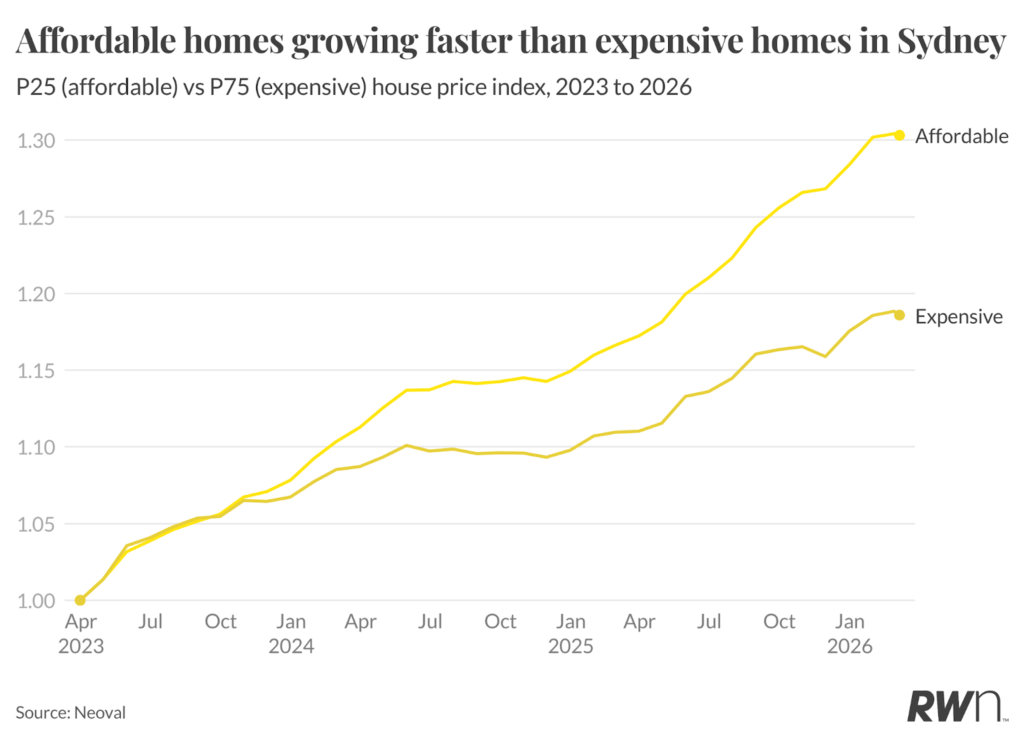
Now, cheaper homes are outperforming by around four to five percentage points.
The shift is being driven by a surge in first-home buyer activity, supported by expanded government incentives.
In October 2024, the federal government removed income limits and place caps on its five per cent deposit guarantee scheme while increasing property price thresholds.
The policy change appears to have had immediate effect. ABS lending data shows first-home buyer loans in New South Wales rose 10.9 per cent in the December quarter – roughly double the growth recorded for investor lending over the same period.
Three interest rate cuts have also improved borrowing capacity across the market, adding further momentum to segments where prices remain relatively accessible.
Ms Conisbee pointed to structural factors reinforcing the trend.
“Prices at the upper end of the market are already extremely high, making it increasingly difficult for many households to upgrade into more expensive properties,” she said.
Construction costs have also surged, making existing homes cheaper to buy than new builds in many cases – particularly in the more affordable segments.
Housing supply constraints are compounding the issue as higher building costs and tighter development conditions weigh on project viability.
The pattern is not unique to Sydney. Across all Australian capital cities, homes in the bottom quartile have outperformed more expensive properties over the past year.
Ms Conisbee expects the divergence to continue.
“Price growth at the lower end of the Sydney housing market is likely to continue outperforming over the coming year,” she said.
“While any renewed increases in interest rates may dampen price growth across the market, they are likely to have a greater impact on higher-priced properties, where borrowing requirements are larger and affordability constraints are more binding.”

