
Australia’s rental market has shifted gear from acceleration to consolidation, but affordability pressures remain firmly in place.
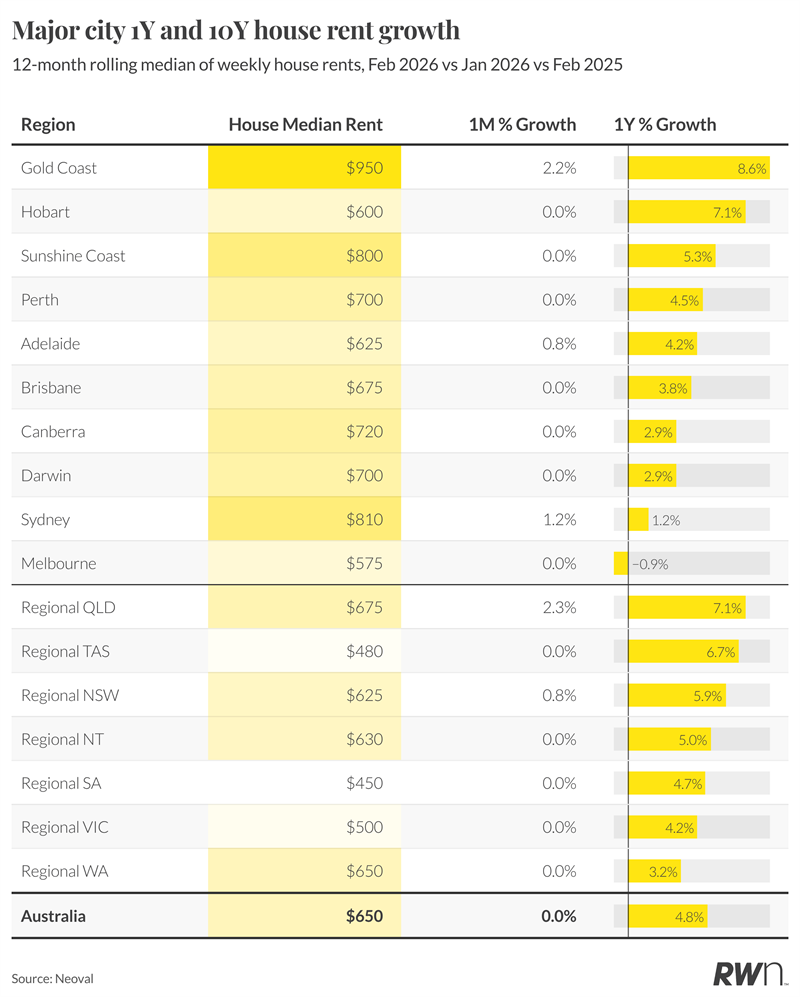
National weekly house rents have reached $650 and unit rents $625, with annual growth running at 4.8 per cent for houses and 4.2 per cent for units, according to Ray White’s latest rental analysis.
The headline figures mask a significant reshuffling of Australia’s rental hierarchy.
The Gold Coast has become the most expensive capital city market for houses, with median weekly rents hitting $950 – well above Sydney at $810 and Melbourne at $575.
Perth houses now rent for $700 per week, ahead of Brisbane at $675 and Adelaide at $625.
“This shift in relative affordability is notable,” said Ray White Chief Economist Nerida Conisbee.
“Historically, Sydney and Melbourne have dominated the upper end of the rental market. Today, lifestyle and smaller capital markets are competing at the top of the pricing spectrum.”
The Gold Coast is also leading capital city rental growth at 8.6 per cent annually for houses, followed by Hobart and the Sunshine Coast.
Perth, Adelaide and Brisbane remain positive but are moderating, while Sydney recorded modest growth of 1.2 per cent and Melbourne edged slightly lower over the past year.
The unit market tells a different story. Adelaide is recording double-digit annual growth of 10 per cent, with Perth and Brisbane also posting strong gains.
Sydney and Melbourne units are growing at more moderate rates of 4.3 per cent and 3.6 per cent respectively.
Melbourne presents a particular case study.
While recording the weakest annual rental growth of the major capitals, it is the only major capital where rental growth has outpaced price growth since 2020.
House prices have risen 32 per cent over that period, while rents have increased 37 per cent.
“The moderation in capital growth has not translated into lower rents across the cycle,” Ms Conisbee said.
“Instead, the burden of adjustment has been carried more through income than capital gains.”
Regional data shows rental acceleration has become concentrated rather than disappeared.
Several Adelaide SA4 regions continue to post double-digit unit growth, Perth’s outer-metro house markets are recording firm annual gains, and parts of regional Queensland continue to exceed the national average.
Inner-city unit markets are also stabilising at elevated levels. Parts of inner Melbourne, inner Sydney and Brisbane’s inner city have firmed following the post-pandemic rebound in migration and student demand, with vacancy rates remaining tight.
Ms Conisbee said the national picture is best described as a transition rather than a downturn.
“The surge phase may be behind us, but rents are not retreating nationally. Instead, Australia’s rental market is recalibrating, with sharp differences in cost and momentum between cities.”

