Australia’s rental market tightened sharply in February, with the national vacancy rate dropping to just 1.1% – a clear signal that demand is far outpacing supply. According to SQM Research, only 34,572 rental properties were available nationally, underscoring an unusually fierce start to the year that goes beyond typical seasonal patterns.
“The national vacancy rate falling to 1.1% shows the rental market remains very tight across most of the country,” said Louis Christopher, Managing Director of SQM Research.
“While some seasonal tightening is expected at this time of year, demand for rental housing is clearly continuing to outstrip available supply and so this move goes beyond normal seasonality.”
Brisbane, Perth and Darwin all recorded vacancy rates at or below 0.8%, with Perth holding steady at 0.6% amid what SQM describes as “extremely limited new supply.”
Darwin posted the sharpest monthly decline, falling from 0.8% to 0.6%, leaving just 144 dwellings available for rent across the city.
Canberra also saw significant tightening, dropping from 1.4% in January to 1.1% in February, while Sydney’s vacancy rate fell from 1.5% to 1.3%.
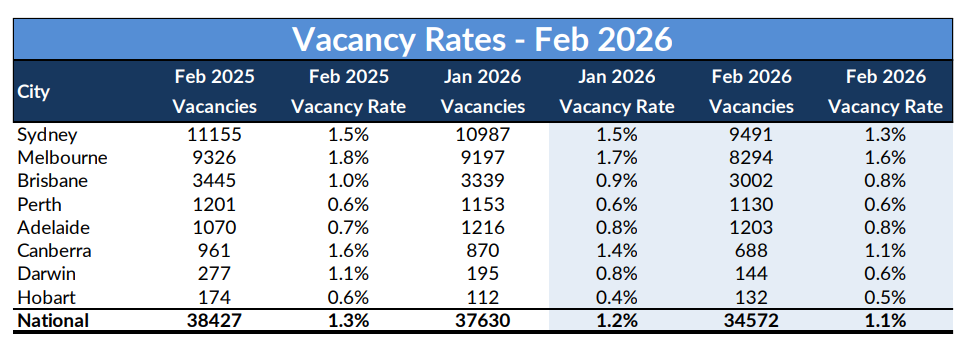
Melbourne remains the loosest major market at 1.6%, though this still represents a tightening from 1.7% the previous month.
Hobart was the only capital to record an increase, edging up from 0.4% to 0.5% – though it remains one of the tightest markets nationally with just 132 dwellings available.
National asking rents rose 6.6% over the past 12 months, with the combined average now sitting at $688.76 per week. Capital city rents averaged $782.57.
Darwin and Hobart recorded the strongest annual rent growth at 12.7% and 12.2% respectively.
Brisbane followed with 8.0% annual growth, while Sydney posted 7.3% gains – with average house rents in the harbour city now at $1,145.45 per week.
Perth rents rose 5.5% over the year, Melbourne 5.0%, and Adelaide 2.8%.
Canberra was the only market to record falling rents, down 2.5% annually.
“Vacancy rates below one per cent in cities such as Brisbane, Perth and Darwin highlight just how constrained rental supply remains in parts of Australia,” Mr Christopher said.
“Without a meaningful lift in new housing supply and an easing in demand, rental pressures are likely to remain a feature of the market through much of 2026, which may feed into the CPI.”