Rental conditions have improved for tenants across Australia, with the national vacancy rate climbing to its highest level since February 2022.
Data released by realestate.com.au shows the national vacancy rate increased by 0.19 percentage points in January to reach 1.48 per cent.
Despite the improvement, conditions remain significantly tighter than five years ago when the vacancy rate sat at 2.3 per cent during the pandemic.
“Conditions for renters have improved over the past three months, though they remain largely unchanged from a year ago,” said Anne Flaherty, Senior Economist at REA Group.
“They are significantly below the conditions renters faced during the pandemic five years ago.”
Melbourne recorded the highest vacancy rate of any capital city at 1.81 per cent, up 0.22 percentage points over the month.
Darwin followed at 1.76 per cent, with the ACT at 1.59 per cent.
Sydney’s vacancy rate rose just 0.10 percentage points to reach 1.55 per cent.
At the other end of the spectrum, Hobart remains the most challenging market for renters despite recording the largest monthly jump in vacancy among capitals.
The Tasmanian capital sits at just 0.72 per cent vacancy – the tightest in the country.
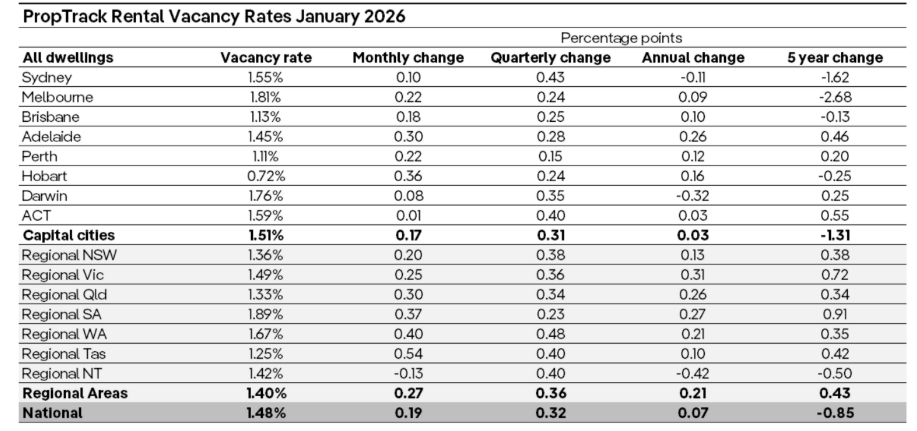
Perth and Brisbane follow as the next most constrained markets, with vacancy rates of 1.11 per cent and 1.13 per cent respectively.
“With the highest vacancy rate of any capital city, renters in Melbourne are facing greater rental availability,” Flaherty said.
“On the flipside, renters in Hobart face the most challenging conditions, with just 0.72 per cent of rentals sitting vacant.”
Regional markets have seen more significant relief than capital cities.
Vacancy rates in regional areas increased by 0.21 percentage points annually, compared to just 0.03 percentage points in combined capital city areas.
Capital city vacancy rose 0.17 percentage points to 1.51 per cent in January, sitting slightly above the regional rate of 1.40 per cent.
Despite the easing conditions, Flaherty warned that rents are still likely to climb.
“While the pace of rent growth has slowed across most markets over the past year, continued low vacancy rates are expected to drive rents to new highs in 2026, particularly in markets where supply is constrained, such as Hobart, Perth, and Brisbane.”